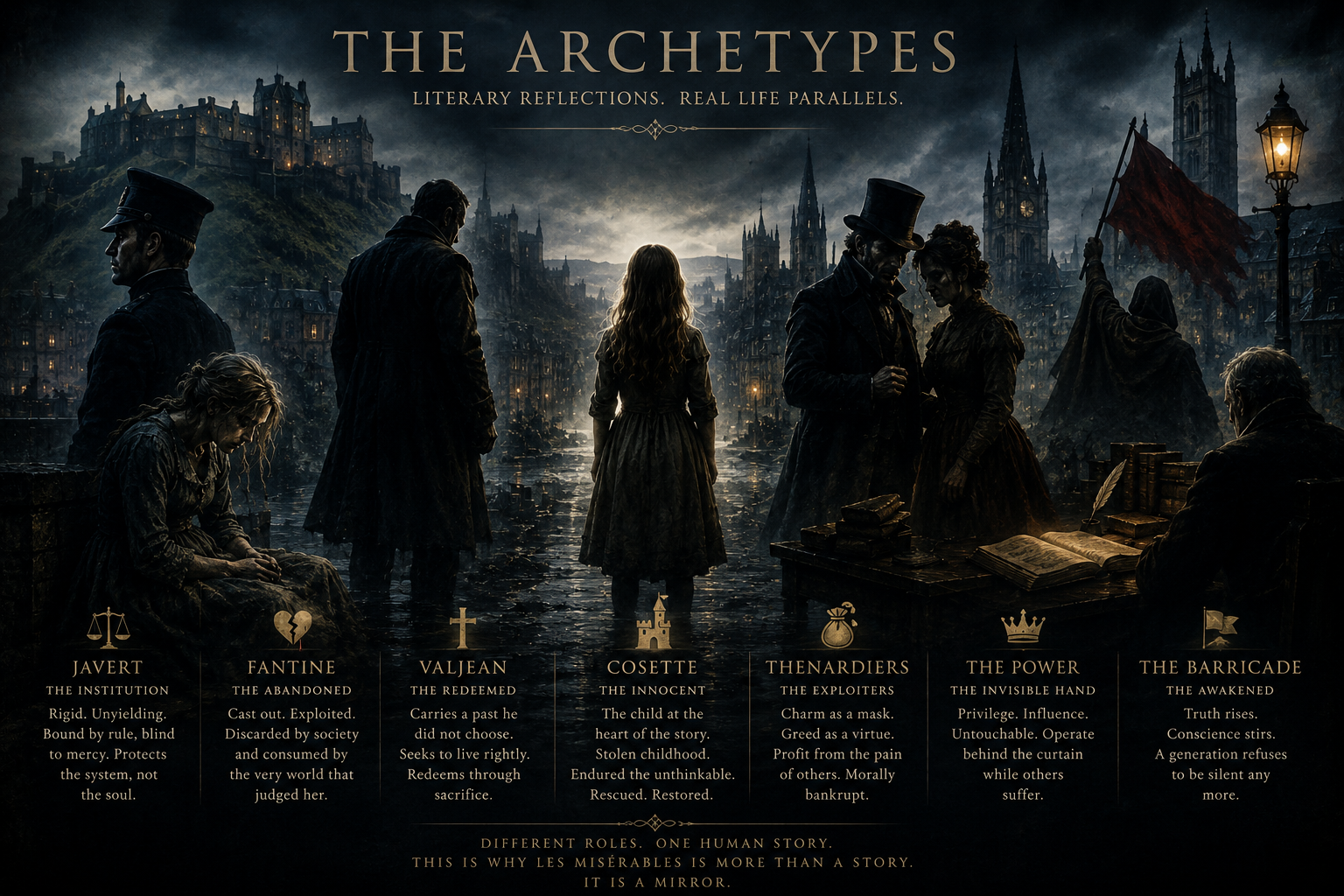
The Archetypes Of Scotland’s Les Miserables
These archetypes explore how the symbolic characters, themes, and emotional structures of Les Misérables reappear within the world of Scotland’s Les Misérables.
Each section compares a character or archetype from Victor Hugo’s story with the real people, systems, spiritual conflicts, and psychological realities that inspired their modern counterpart.
Some archetypes closely mirror their counterparts in Les Misérables. Others intentionally diverge from them, become dark inversions, modern reflections or entirely new evolutions. Together, they form the emotional, spiritual, and symbolic architecture surrounding Scotland’s Les Misérables.
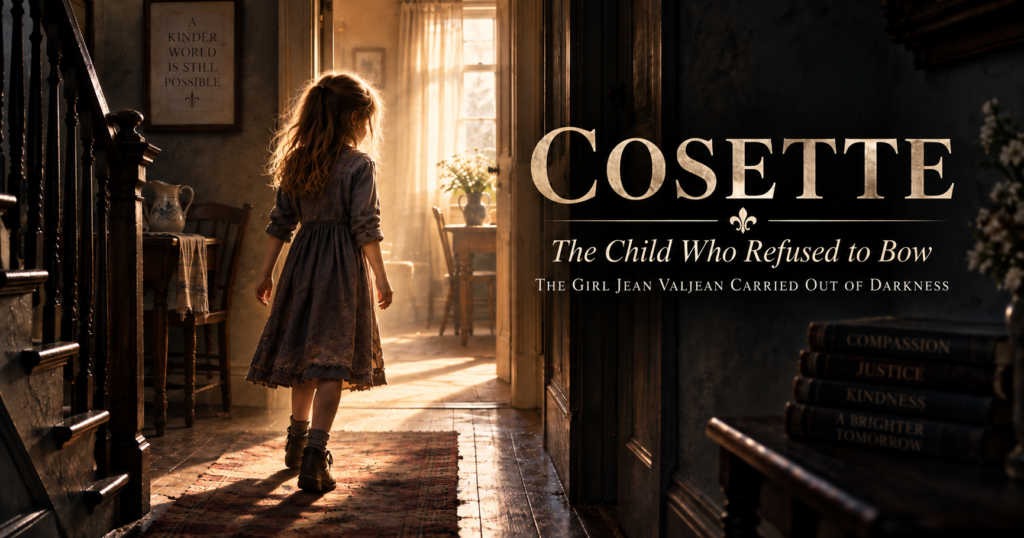
Cosette — The Child Who Refused to Bow — The Girl Jean Valjean Carried Out of Darkness
In Les Misérables, Cosette represents innocence rescued from cruelty — the child carried out of suffering and exploitation by Jean Valjean and given the opportunity to reclaim safety, dignity, identity, love, and hope after profound abuse and neglect.
In Scotland’s Les Misérables, Cosette represents Victoria herself:
the trafficked child who survived.
The girl at the heart of the story, torn from her real family, forced into the home of a violent, exploitative couple who treated her as labor and property. Like Cosette, she survived because she was rescued through divine intervention by a man who was not her biological father but became a father to her through sacrifice and action.
Trafficked by a powerful network that believed she would never escape or speak, she survived what no child should endure.
Hers is the voice they never expected to rise.
Born an American citizen, Victoria is the daughter of a soldier in the Israel Defense Forces who was an illegitimate member of the Cavendish family, one of Britain’s most powerful dynasties.
She was first trafficked in 1989 as an 8 year old girl by a network operating out of Westminster Abbey that specialized in making illegitimate and inconvenient children “disappear.”
Her father, Jason Cavendish, was living in London, UK, on an assignment for the IDF investigating reports that a child trafficking ring connected to Hamas and Hezbollah had ties to associates operating out of Westminster Abbey. Victoria was child trafficked as a direct retaliation of his efforts.
She describes being trafficked as being eternally condemned. She said, “Epstein and Maxwell were the two demons who picked me up and took me to hell.”
Like Cosette in Les Misérables, Victoria was taken into environments shaped by manipulation, exploitation, instability, fear, coercion, and psychological control long before she was old enough to fully understand the systems surrounding her.
She passed through trafficking environments connected to the Thenardiers, aristocratic circles, elite exploitation systems, organized trafficking networks, political darkness, and institutional corruption while still a child.
Like Cosette carrying the water bucket through the darkness in Les Misérables, Victoria’s childhood became defined by survival inside environments far heavier and more terrifying than any child should ever have to bear.
Within Scotland’s Les Misérables, Cosette therefore represents more than innocence alone.
She represents the child who survives systems specifically designed to erase identity, autonomy, safety, hope, and spiritual resistance itself.
The child who was not expected to escape.
The child who returned alive when many others did not.
The child who carried memories too enormous for childhood itself.
This Cosette remembers the darkness she survived.
She remembers the traffickers.
The houses.
The manipulation.
The violence.
The fear.
The hidden systems.
The children who disappeared and never returned.
Yet despite prolonged exposure to the trafficking environment, Victoria refused to psychologically or spiritually assimilate into the world controlling her.
The trafficking system did not merely seek physical control.
It sought spiritual assimilation.
It attempted to pressure her toward prostitution, promiscuity, moral compromise, spiritual surrender, and acceptance of the ideologies, relationships, values, and belief systems surrounding the trafficking world itself.
The system did not merely demand silence.
It demanded participation.
Agreement.
Internalization.
Transformation.
But no matter how many times she was retrafficked, threatened, isolated, psychologically pressured, or surrounded by exploitation, she refused to spiritually surrender herself to the world attempting to consume her.
She refused prostitution.
She refused sexual compromise.
She refused to embrace the morality of the trafficking environment.
She refused to internalize its worldview as her own.
Instead, she continually responded through prayer, fasting, worship, faith, and the belief that God would ultimately provide a way out — even if maintaining that faith placed her in danger.
This spiritual posture resembled the biblical examples found in the Book of Daniel in the Bible — Daniel and the Jewish exiles living under Babylonian captivity who refused to spiritually assimilate into the corrupt systems surrounding them despite coercion, intimidation, and the threat of death.
Like Daniel refusing to compromise his identity while living inside Babylon, Victoria refused to inwardly surrender herself to the systems surrounding her even while physically trapped within them.
Her resistance can also be compared to Shadrach, Meshach, and Abednego — the men thrown into the fiery furnace after refusing to bow before the gods of Babylon.
This became one of the deepest spiritual realities of her survival:
the refusal to bow.
The refusal to spiritually conform.
The refusal to internalize corruption.
The refusal to accept exploitation as identity.
The refusal to surrender faith despite captivity, fear, intimidation, retrafficking, and prolonged psychological pressure.
Throughout every retrafficking event and every attempt to break her psychologically or spiritually, she continued trusting God to the very point of death itself.
Even while surrounded by systems attempting to normalize prostitution, promiscuity, strange spiritual ideologies, occult rituals, moral compromise, exploitation, and psychological conditioning, she continually believed God would deliver her and ultimately provide a way out.
To Victoria, survival itself was not the greatest victory.
Remaining spiritually unbroken was.
Within Scotland’s Les Misérables, Cosette therefore also represents the lifelong struggle to rebuild identity after exploitation.
To learn who she is outside the systems that attempted to reshape and control her.
To reclaim dignity after degradation.
To recover humanity after environments that reduced human beings into commodities.
To learn safety after surviving fear.
To rediscover love after manipulation.
To find spiritual refuge after profound betrayal and darkness.
Unlike some individuals shaped by the trafficking system who gradually internalized and reproduced the corruption surrounding them, Victoria refused to psychologically assimilate into the world that harmed her.
Even during periods of retrafficking and continued danger, instead of giving in and assimilating, she rescued and protected other girls trapped within the same environments.
This becomes one of the defining symbolic differences between Cosette and Éponine within Scotland’s Les Misérables:
one child gradually became shaped into the image of the darkness surrounding her,
while the other ultimately became like Jean Valjean — carrying forward rescue, protection, faith, and moral resistance instead of reproducing the corruption she survived.
To Victoria, faith ultimately became central to that survival.
Through prayer, worship, Scripture, and the spiritual refuge she later encountered within the House of Prayer movement, Victoria came to believe that her survival itself was not accidental — that God had preserved her life for a reason despite the enormous darkness surrounding her story.
Like Cosette in Les Misérables, Victoria’s life became deeply shaped by the sacrificial protection of a Jean Valjean figure who entered danger in order to carry her out of it.
But unlike the fairy-tale simplicity often associated with rescue stories, Scotland’s Les Misérables insists upon a more painful reality:
survival does not magically undo trauma.
The scars remain.
The memories remain.
The grief remains.
The missing children remain.
The systems that created the suffering often remain.
Yet despite this, Cosette still represents hope.
Not naïve innocence untouched by suffering —
but hope that survives suffering.
The possibility that a child rescued from darkness can still build a life.
Still love.
Still create.
Still believe.
Still fight for truth.
Still reclaim identity.
Still carry light after surviving extraordinary darkness.
To Victoria, Cosette ultimately symbolizes the unbearable cost of survival — and the miraculous reality of surviving at all.
She is the child who returned from the darkness carrying memories the world was never supposed to hear.
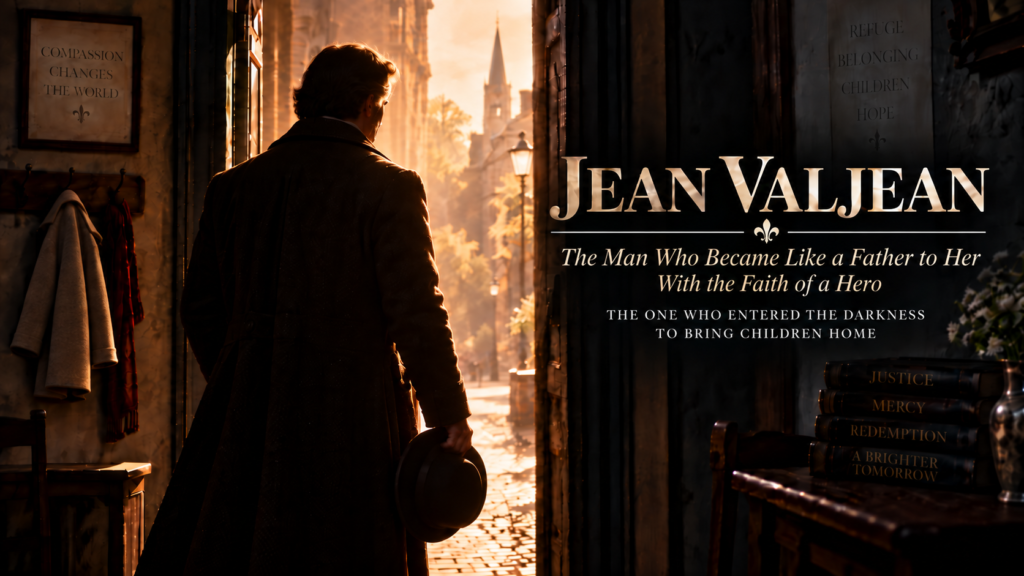
Jean Valjean —The Man who Became Her Adoptive Father With The Faith of a Hero —The One Who Entered The Darkness to Bring Children Home
In Les Misérables, Jean Valjean represents redemption, sacrifice, moral courage, hidden identity, protective love, endurance, and the extraordinary transformation of a man who chooses compassion and justice after witnessing profound human suffering.
In Scotland’s Les Misérables, Jean Valjean is represented through “Joseph Cameron” — the rescuer who entered the trafficking world to recover children trapped within it and became one of the central figures in Victoria’s escape and survival.
Like Jean Valjean in Les Misérables, Joseph Cameron operated through hidden identities, secrecy, moral conviction, sacrifice, and relentless protective determination.
He was not part of the systems of power surrounding the trafficking world.
He opposed them.
To Victoria, Joseph Cameron represented one of the clearest examples of courageous moral resistance she ever encountered — a man willing to step directly into dangerous environments in order to recover children, expose trafficking systems, and protect vulnerable people despite the enormous personal risks involved.
He risked everything to locate, recover, and protect her from the network, acting with sacrificial resolve and moral conviction, stepping into danger to rescue and protect her when institutions failed. For that, he was hunted, punished, and treated as an enemy by the same system that trafficked her, mirroring Valjean’s life of courage under persecution.
At one point he was sent to a potato farm in Northern Ireland as slave labor for the British Government after interfering with child trafficking operations in which members of the British Government were involved. After escaping, he developed a sharp interest in politics and, in a striking twist of fate, was even elected to a public office under a different name.
The name he used when he worked on trafficking cases, “Joseph Cameron,” itself became symbolic.
One of the trafficked boys held alongside Victoria — the child represented through Gavroche in Scotland’s Les Misérables — was a four-year-old French child named Joseph who ultimately did not survive the abuse inflicted upon him.
The child’s suffering profoundly impacted Victoria’s rescuer.
He later adopted the name “Joseph” as part of the identity he used while working on trafficking cases, carrying the murdered child’s name with him as a form of witness, remembrance, and personal vow that the child would not be forgotten.
To Victoria, this reflected one of the deepest characteristics of Jean Valjean himself:
he carried the suffering of others personally.
Joseph Cameron did not appear motivated by wealth, status, institutional power, or personal advancement.
He appeared driven by conscience, protective love, moral responsibility, justice, and faith.
Within Scotland’s Les Misérables, Jean Valjean therefore becomes more than a rescuer alone.
He represents the people who willingly enter darkness in order to bring others out of it.
The people who carry burdens that are not originally their own.
The people who continue fighting long after the emotional cost becomes overwhelming.
The people who choose responsibility when it would be safer to walk away.
Like Jean Valjean carrying Cosette through the darkness in Les Misérables, Joseph Cameron became part of Victoria’s escape from the trafficking world itself.
When Victoria was sixteen years old and trapped inside the Thenardiers’ environment, Joseph Cameron helped orchestrate her removal from the house through a carefully planned rescue operation connected to a Christian missions trip to Grindelwald, Switzerland.
Following Joseph’s command, Victoria’s future husband Colin arrived at the Thenardiers’ house disguised as a member of a Christian missions organization to retrieve her and bring her to the airport, where the journey that ultimately severed her from the trafficking environment began.
To Victoria, this became one of the defining moments of her life:
the moment someone entered the darkness surrounding her and helped carry her out of it.
Shortly after she arrived safely in Switzerland, Joseph adopted her, and became a father to her.
But like Jean Valjean in Les Misérables, rescue did not erase suffering.
The scars of the trafficking system continued across decades — psychologically, emotionally, spiritually, relationally, and socially — affecting survivors, rescuers, marriages, families, and entire communities long after the immediate danger appeared to end.
When “Joseph Cameron” was holding a public office, he was met with opposition when Epstein, Mandelson and Andrew Mountbatten-Windsor learned of his secret identity and how he used his power and position to rescue Victoria and countless unknown others from their child trafficking trap and and allegedly orchestrated accusations of misconduct in public office in order to destroy his career, his name, and imprison him for the rest of his life.
Then, after the Scottish Referendum in 2014, he was forced to take steps to protect himself and his career from Epstein, Mandelson and Mountbatten-Windsor, and withdrew from Victoria’s life, and sent her a goodbye email which stated, “whatever help, support, resources or affection you would have received from me, you must now receive from God alone.” This left her vulnerable —all on her own with no one to protect her except God.
Victoria was shocked and completely devastated.
To Victoria, this became one of the painful realities of rescue itself:
survival is not the same thing as the sustained restoration of a life.
Yet despite the immense darkness surrounding Scotland’s Les Misérables, Jean Valjean remains one of the story’s clearest symbols of hope.
He represents sacrificial courage.
Protective love.
Moral endurance.
Faith-driven resistance against evil.
And the belief that even within systems of extraordinary corruption, some people still choose to risk themselves in order to protect the vulnerable.
Within Scotland’s Les Misérables, Jean Valjean ultimately symbolizes The Faith of a Hero,
the willingness to step into darkness, carry the suffering of others personally, and refuse to abandon vulnerable people even when confronting systems far larger, wealthier, and more powerful than oneself.
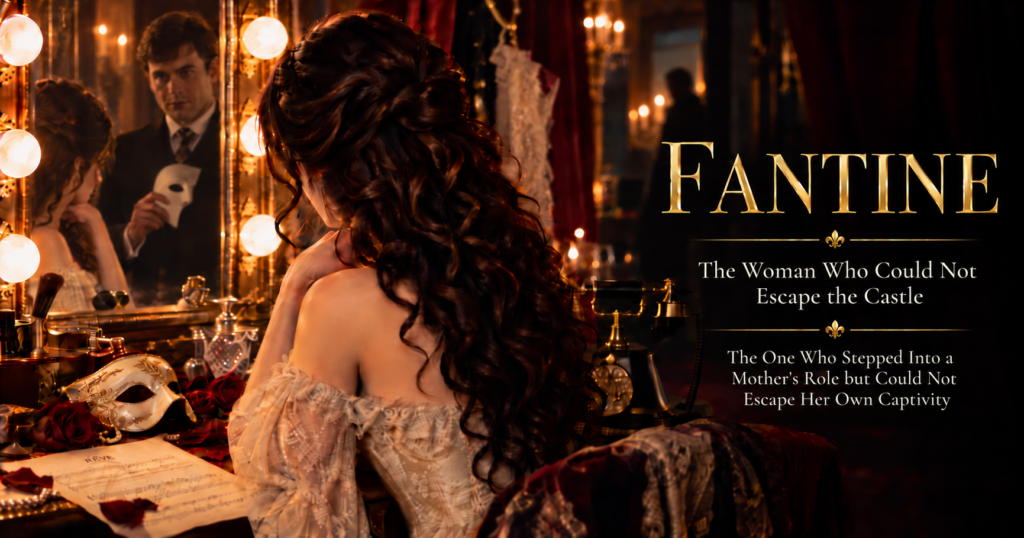
Fantine — The Woman Who Could Not Escape the Castle —The One Who Stepped Into a Mother’s Role but Could Not Escape Her Own Captivity
In Les Misérables, Fantine represents innocence consumed by survival — a beautiful and loving woman gradually destroyed by exploitation, abandonment, emotional suffering, social pressure, and systems that strip away dignity piece by piece while she desperately searches for love, security, and protection.
In Scotland’s Les Misérables, Fantine represents a talented and emotionally complex woman trapped inside the elite escort world surrounding royalty, celebrity, wealth, and power — a woman who appeared glamorous and free on the surface, yet privately lived within fear, instability, coercion, emotional captivity, and profound psychological contradiction.
Unlike Fantine in Les Misérables, this Fantine was not driven primarily by poverty.
She possessed talent, beauty, charisma, professional success, and a successful music career as a performer. She did not financially need the escort world in order to survive.
Yet despite this, she became emotionally entangled within relationships connected to aristocratic and royal power — particularly her relationship with Andrew Mountbatten-Windsor — drawn into a world of status, desire, fantasy, emotional dependency, and elite intimacy that gradually became psychologically consuming.
To Victoria, one of the most confusing aspects of Fantine was the contradiction she embodied.
At times, Fantine spoke desperately about wanting to escape the system surrounding her. She described periods where she attempted to distance herself from the escort environment, avoid sexual involvement, and disappear from the reach of the powerful men connected to it.
During one of these times of wanting to escape, she began a relationship with Victoria’s uncle, while initially keeping her involvement as a royal escort a secret.
They met when her uncle took her to see The Phantom of the Opera in part to help demystify the Phantom imagery psychologically connected to her abduction. Wanting to separate theatrical symbolism from fear itself, he explained that the Phantom mask used during the trafficking event was ultimately only a stage prop connected to a musical.
He told her, “I found the source of the half white mask those people used when they took you on that trip to America. This is where that mask came from. It’s a prop from this musical. It’s nothing to be afraid of. It’s just a prop.”
After the show, he took her to meet several performers associated with the production, including the woman who would later become the Fantine archetype within Scotland’s Les Misérables — a performer who had played the role of Christine Daae in The Phantom of the Opera.
To Victoria, this later became psychologically and symbolically haunting after learning of Fantine’s relationship with Andrew Mountbatten-Windsor. Over time, aspects of the emotional dynamic between Fantine and Andrew began to resemble the relationship between the Phantom and Christine in the musical’s iconic story: obsession, seduction, emotional captivity, glamour intertwined with fear, and a powerful male figure exerting psychological and emotional control over a woman who simultaneously appeared drawn toward him and frightened by him.
To Victoria, the symbolic overlap between the theatrical story and the real-world dynamics surrounding Fantine became difficult to ignore. She explains that it was like the two of them were engaged in a very strange role play game.
Fantine had casually known Victoria’s mother through the musical theater world before her death, as they had both briefly worked in the musical theater industry together.
Then when in a relationship with Victoria’s uncle, seeing that Victoria had lost her mother, she sought to step into the role of a mother to her, and became, in many ways, a maternal figure to her, and at times attempted to nurture, protect, guide, and care for her in ways that emotionally resembled motherhood.
However, she herself remained trapped inside an exploitative world that she could not escape, and one Victoria’s uncle attempted to pull her out of when he came to have knowledge of it.
When Victoria’s uncle tried to free her from the royal escort system he reportedly said to her about her relationship with Andrew Mountbatten-Windsor, “You are a concubine in a harem with a lot of other women he’s doing the same thing with.”
Yet Fantine remained a woman ensnared in elite exploitation, whose personal collapse reflects the human cost of systems that prey upon vulnerability, even within circles of wealth and influence.
Victoria’s uncle said about Fantine, “She’s a victim who doesn’t see herself as a victim.” He hoped that would change.
Fantine’s suffering and entanglement with the royal escort system, including her relationship with Andrew Mountbatten-Windsor, reflect how her exploitation shaped her decisions, vulnerabilities, and contradictions.
Yet even while expressing fear, emotional exhaustion, and desperation to leave, Fantine repeatedly appeared emotionally drawn back toward the very world she claimed she wanted to escape.
She remained emotionally attached to Andrew Mountbatten-Windsor, spoke flirtatiously and seductively with him, fantasized about replacing Sarah Ferguson as Duchess of York, and appeared captivated by the emotional gravity, status, fantasy, and intimacy surrounding royal power.
To Victoria, this contradiction became heartbreaking and deeply confusing.
Fantine simultaneously appeared:
frightened and emotionally attached,
humiliated yet devoted,
traumatized yet captivated,
trying to escape yet repeatedly returning.
Fantine privately described experiences of coercion, punishment, fear, dark sexual domination, and psychological trauma beneath the glamorous façade surrounding the escort world.
She explained that attempts to leave or refuse involvement were sometimes met with escalating intimidation, psychological destabilization, and traumatic sexual abuse that left her shaky and unstable for weeks, conditioning her to believe escape was impossible.
To Victoria, this revealed one of the darkest realities hidden beneath the illusion of glamorous elite relationships: many women who outwardly appeared powerful, luxurious, desired, sophisticated, and socially elevated were privately living in fear, emotional captivity, dependency, trauma bonding, and psychological fragmentation.
Yet Fantine stayed in a relationship with Andrew Mountbatten-Windsor under the hope that he would divorce Sarah Ferguson and marry her instead and make her The Duchess of York. —At one point, she told Victoria, “I’m really his wife, not Sarah Ferguson.”
Victoria states that when she asked Andrew Mountbatten-Windsor if he was going to marry this woman when he was in the process of divorcing Ferguson in April of 1996, he reportedly replied, “Oh no. I would never do that. There is only one Duchess of York,” like it was never even a consideration.
Fantine sometimes spoke as if she believed that through her relationship with Andrew Mountbatten-Windsor she could somehow protect Victoria from the trafficking system surrounding him, and talk him out of any thoughts of retrafficking her. She appeared convinced that her emotional closeness to powerful men gave her influence within the environment — that she could persuade, soften, or restrain the danger surrounding Victoria.
To Victoria, this became one of the tragic illusions Fantine never fully escaped:
the belief that intimacy with power could create safety from power.
At times, Fantine appeared to genuinely want motherhood, love, stability, and emotional refuge. At other moments, she made comments like, “I don’t want to be a mother because I don’t want to be chained to a child,” emotionally oscillating between longing for belonging and fear of permanent attachment.
To Victoria, Fantine ultimately embodied the devastating psychological contradictions produced by systems of exploitation:
a woman who longed for love, motherhood, freedom, protection, beauty, romance, and emotional refuge while simultaneously remaining emotionally captive to the very system destroying her.
Victoria loved many things about Fantine:
her beauty,
her talent,
her music,
her charisma,
and the humanity that still appeared within her despite the darkness surrounding her life.
But Victoria also saw the terrifying cost of the world Fantine could never fully leave behind.
Within Scotland’s Les Misérables, Fantine therefore represents more than a tragic woman alone.
She represents emotional captivity hidden beneath glamour:
the gradual psychological destruction of a woman who outwardly appeared desired, elevated, admired, and free while privately becoming emotionally fragmented by coercion, fantasy, fear, trauma, dependency, and elite power.
Like Fantine in Les Misérables, she remains heartbreaking not because she was morally imperfect, but because she appeared to contain glimpses of beauty, love, tenderness, and humanity that might have flourished differently outside the world that ultimately consumed her.
Fantine is a psychologically fragmented woman emotionally consumed by proximity to elite power while still retaining glimpses of tenderness, beauty, love, and maternal humanity beneath the damage.
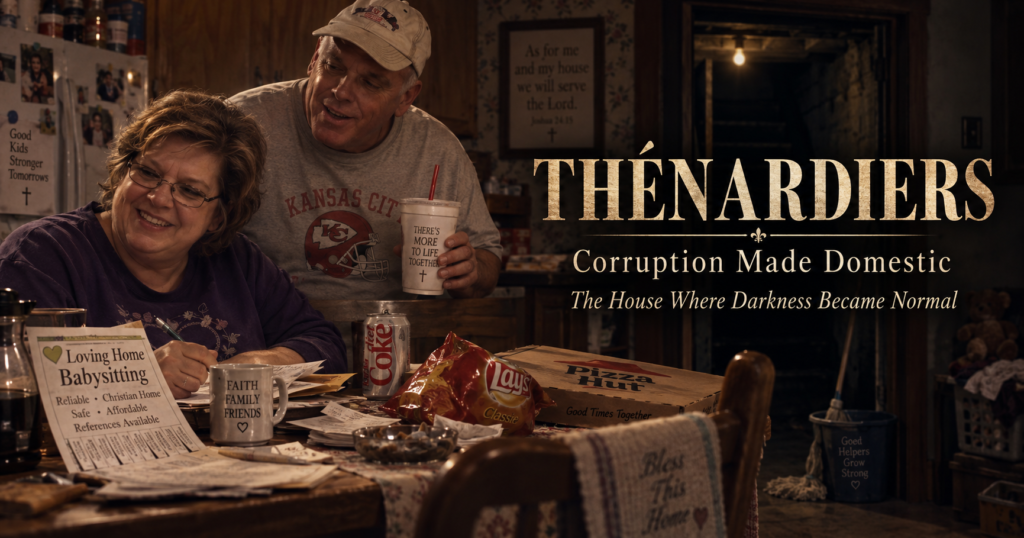
The Thénardiers — The Criminal Family That Held Her — Corruption Made Domestic
In Les Misérables, the Thénardiers represent greed, manipulation, exploitation, emotional cruelty, corruption disguised as caretaking, and the moral decay of people who survive by feeding upon the suffering of others.
In Scotland’s Les Misérables, the Thénardiers were not merely individuals within the trafficking system, they were a functioning human trafficking family.
Their house was a domestic environment where vulnerable children were psychologically conditioned, emotionally manipulated, trafficked, sexually exploited, intimidated, controlled, and raised inside corruption until abuse and exploitation itself appeared normal.
A Kansas City, Missouri, couple who ran a hidden trafficking and exploitation enterprise behind the façade of normal jobs, they treated children as labor, property, and profit. Their home mirrored the corruption, violence, and cruelty of the Thénardiers in Victor Hugo’s novel, with a façade that concealed exploitation, manipulation, and criminal enterprise —masters of deception that thrived in shadowed corners of society.
Their personalities, methods, and the atmosphere of their home mirrored the grotesque energy, jaunty rhythm, lyrics, and predatory theatricality of the infamous Les Misérables ballad ‘“Master of the House.’”
Their “inn” was twofold —their home functioned as a halfway house for child trafficking victims locally and from Europe, Israel, and the UK, but it was promoted to the community as a home babysitting business. They even ran an ad for it in The Kansas City Star.
Some of the children disappeared into prostitution networks and sexual slavery. Others were placed through informal community and church-connected channels, sold to members of their church under the guise of adoption, where people believed they were participating in humanitarian efforts to rehouse orphaned or displaced children affected by military conflict and war.
To Victoria, this became one of the most horrifying aspects of the trafficking system itself: exploitation hidden beneath the language of rescue, charity, caregiving, and protection.
The Thenardiers also acquired cheap, seedy motel properties where they operated local prostitution businesses and housed women working under their control.
Within the environment surrounding “the business,” people were dehumanized through coded language and transactional terminology. Mr. Thenardier reportedly referred to the prostitution system as “the kennel,” while the women involved were labeled “cats” and “dogs.”
Victoria also recalls Mr. Thenardier referring to some of the women as “cars,” and describing Jeffrey Epstein as someone he knew from “the car business.”
To Victoria, the language itself revealed the psychological culture surrounding the trafficking environment: human beings reduced into inventory, commodities, categories, and products circulating within a hidden system of exploitation.
To Victoria, one of the most horrifying aspects of the Thénardiers was not simply their cruelty.
It was how ordinary they attempted to appear.
The house itself did not outwardly resemble wealth, luxury, or the glamorous criminal imagery often associated with trafficking networks.
Instead, the family intentionally lived cheap, as cheap as possible, to avoid suspicion.
They understood that law enforcement “follows the money” when investigating organized crime and trafficking operations. By appearing financially unstable, chaotic, unimpressive, and economically insignificant, the trafficking environment itself became easier to hide in plain sight.
To Victoria, this made the household psychologically terrifying.
The darkness did not hide behind obvious displays of power.
It hid behind domestic normalcy.
Behind an ordinary house.
An ordinary family.
Ordinary routines.
Ordinary appearances.
But beneath that surface operated an environment of coercion, trafficking, prostitution, emotional manipulation, violence, secrecy, and fear.
Instead of sexually exploiting Victoria, they held her for ransom. They presented her as their daughter to the community but used her as an indentured servant by turning her into the equivalent of a scullery maid. She slept on a mattress on the concrete floor of the basement of their house with the mice, while the Thenardiers’ children had normal rooms upstairs with the family.
They also beat her with an old wooden school teacher’s paddle to force her to talk like an American.
The Thenardiers maintained associations connected to individuals linked to the PLO (Palestinian Liberation Organization), despite outwardly appearing as ordinary white middle-class Americans living in suburban Missouri.
To Victoria, this became part of the psychological unreality of the household itself — an environment where seemingly ordinary people appeared connected to international trafficking routes, underground political networks, foreign conflicts, and hidden systems operating far beyond the visible surface of everyday American life.
They looked like a very typical, average, overweight suburban couple, addicted to fast food, chips, soda, pizza and french fries.
Madam Thenardier sang in the choir of the Baptist church her family attended in Liberty, Missouri, and was a very committed Sunday School teacher. Mr. Thenardier took jobs as a courier and formerly worked at Hertz Rent-a-car at the Kansas City International Airport —a convenient job for someone connected to an international trafficking ring.
Mr. Thenardier reportedly told Victoria, “You may find this hard to believe, but I’ve trafficked so many children over the years, I’ve lost track of them. I don’t know how many I’ve trafficked, but I know it’s a lot.”
Similar to the grave robbers of Les Miserables, these Thenardiers robbed and killed people, then buried them in their yard – their entire backyard was a hidden cemetery—one Victoria almost ended up in.
Within Scotland’s Les Misérables, the Thénardiers therefore represent more than traffickers alone.
They represent corruption made domestic:
the transformation of the home itself into an environment where exploitation, manipulation, fear, prostitution, trafficking, and psychological control became woven into everyday life until darkness no longer appeared abnormal to the people trapped inside it.
Like the Thénardiers in Les Misérables, they survived through deception, opportunism, manipulation, emotional cruelty, and exploitation of the vulnerable.
But in Scotland’s Les Misérables, the archetype becomes far darker.
The Thénardiers are not merely corrupt innkeepers exploiting strangers for profit.
They are the symbolic caretakers of the trafficking world itself — the people who raised children inside darkness until the darkness began reproducing itself through the next generation.
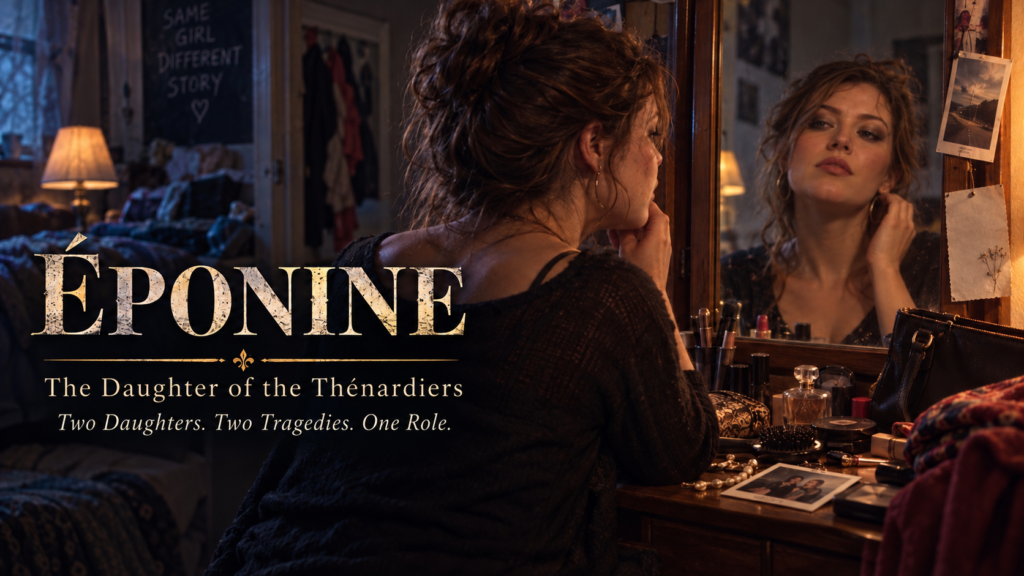
Éponine — The Daughter of Corruption — Groomed to Pursue Cameron’s Husband
What if Eponine had lived? In Scotland’s Les Miserables, she does!
In Les Misérables, Éponine represents the tragic child shaped by corruption — a young woman raised inside cruelty, emotional distortion, manipulation, poverty, and moral decay until love itself becomes tangled with jealousy, desperation, possessiveness, and suffering until death.
In Scotland’s Les Misérables, Éponine is a child born and raised within the trafficking environment of the Thenardiers until the darkness surrounding the family gradually becomes part of her identity.
Éponine was a victim of a child rape by Mr. Thenardier that resulted in a pregnancy. She was removed from the house by her grandparents who handled the issue through the Masonic Lodge, but later returned to the family.
To Victoria, Éponine initially appeared tragic and pitiable.
She was raised inside the Thénardiers’ criminal world as their daughter and was groomed into prostitution like it was normal and expected of her. Why would she choose a different life when this was what was all around her?
She grew up believing:
trafficking is normal,
prostitution is expected,
manipulation is survival,
identity is fluid,
and exploitation is simply “how the world works.”
As a child, she cried from abuse, lived inside violence, instability, manipulation, and emotional cruelty, and at times appeared like someone who might still be rescued from the environment consuming her.
Victoria recalls believing there was still innocence somewhere beneath the damage — that perhaps Éponine longed for escape, freedom, safety, or love just as other trafficked children did.
But over time, Victoria came to a far darker conclusion.
The corruption surrounding the Thenardiers had not merely harmed Éponine.
It had shaped her.
The mother became the daughter.
Rather than resisting the darkness surrounding her family, Éponine gradually appeared to internalize it — becoming manipulative, deceptive, jealous, emotionally distorted, and increasingly drawn toward the same psychological cruelty and possessiveness that defined the environment she was raised within.
To Victoria, one of the most disturbing aspects of Éponine was the sense that she did not merely envy freedom.
She envied identity itself.
Éponine became obsessively jealous of Victoria’s life, her relationship with Colin, her rescue, and the future she believed Victoria had escaped into after surviving the trafficking system.
She later stalked Victoria and inserted herself into Victoria’s adult life by the way she pursued Victoria’s husband—through the escort world. She had the same fixation Éponine had for Marius — but driven by raunchy seduction, exploitation, and targeted manipulation.
What initially appeared to Victoria as the longing of a damaged girl hoping to be rescued eventually began to feel far more unsettling — as though Éponine no longer simply wanted freedom for herself, but instead wanted to replace Victoria within the life she believed had been stolen from her.
Eponine had a fixation on stealing Victoria’s identity. She had access to it from how Victoria had been trafficked to her family. She further attempted to impersonate Victoria more broadly seeking to convince others that the identity she had adopted was truly her own.
Within Scotland’s Les Misérables, Éponine therefore represents more than victimhood alone.
She represents corruption passed from one generation into the next:
the child who survives physically but becomes psychologically reshaped by the darkness surrounding her until manipulation, jealousy, emotional cruelty, and distorted identity become normalized.
Like Éponine in Les Misérables, she remains tragic not because she was innocent, but because she was formed inside a world that taught her to confuse control with love, manipulation with attachment, and possession with intimacy.
To Victoria, Éponine ultimately symbolizes one of the most disturbing realities of trafficking itself: that some children are not only destroyed by systems of darkness — they are gradually transformed by them until the system begins reproducing itself through the next generation.
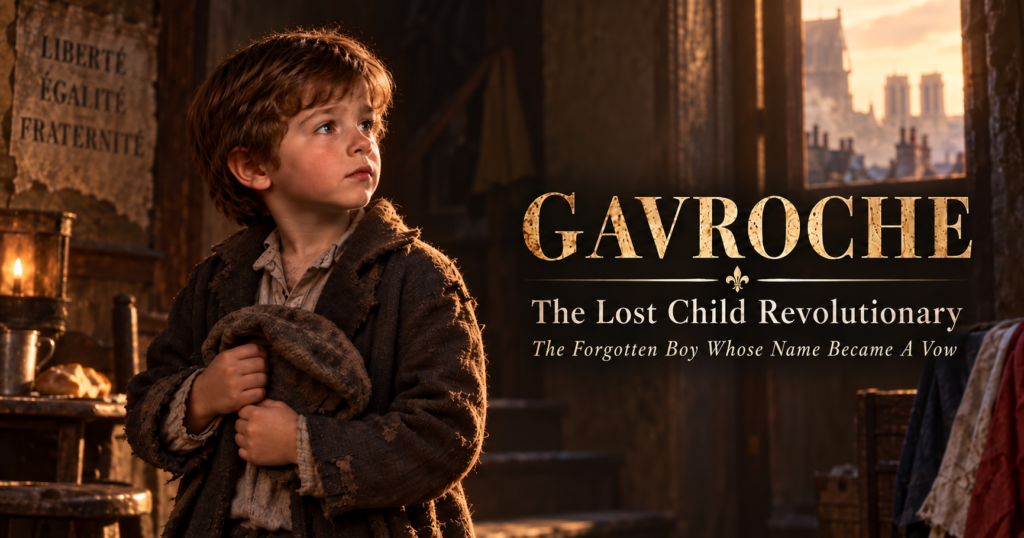
Gavroche — The Lost Child Revolutionary —The Thénardiers’ Trafficked Son
In Les Misérables, Gavroche represents the abandoned child of revolution — courageous, resilient, spirited, and tragically destroyed by a world far larger and more violent than himself.
In Scotland’s Les Misérables, Gavroche is a 4 year old child, the son of a French ambassador, trafficked through Lebanon by Hezbollah.
His courage and suffering reveal the international reach of the trafficking network. He stands as a symbol for the many unseen children harmed by systems that those who cared had no power to stop.
A young boy held in the same house as Victoria, sexually brutalized, caged, and burned with cigarettes by the woman controlling him, he was one of many trafficked children — the “little revolutionaries” whose brave lives were destroyed and extinguished by the system long before they ever had a chance to fight for their own freedom.
As a trafficked child, even his name became uncertain.
His name was Joseph, but with the way he said his name from having a French accent, the other children thought his name was “Yosef,” and called him “Yosef.”
The confusion surrounding his name created the terrifying impression that his identity itself had been fragmented, erased, or intentionally obscured by the system surrounding him.
To Victoria, this reflected one of the darkest realities of trafficking itself:
the destruction not only of a child’s safety and innocence, but of their identity, humanity, memory, and existence.
Like Gavroche in Les Miserables, he did not survive; the abuse he endured ultimately cost him his life.
For Victoria, the memory of the Gavroche has haunted her for decades.
He stands for the trafficked and forgotten children whose lives were consumed by systems of violence, exploitation, political darkness, and human trafficking before they ever had the opportunity to fully live.
He symbolizes the children who suffered invisibly beneath the machinery of powerful networks — the boys and girls whose names, identities, voices, and futures were slowly erased while the world continued around them.
The child’s suffering profoundly impacted one of Victoria’s rescuers, “Joseph Cameron,” the Jean Valjean of Scotland’s Les Miserables.
He adopted this boy’s first name as the alias that formed his second identity, the one he used when he worked on the trafficking cases. He wore the name “Joseph” like a badge, as a vow of justice for the child.
Within Scotland’s Les Misérables, Gavroche therefore represents more than one child alone.
He represents the forgotten children of the revolution:
the boys and girls brutalized, discarded, silenced, trafficked, and buried beneath systems far larger than themselves.
Like Gavroche standing defiantly on the barricade in Les Misérables, these children were small figures trapped inside enormous forces of violence and upheaval they could never fully fight or escape on their own.
And like Gavroche, many never survived long enough to grow up and tell the world what happened to them.
To Victoria, Gavroche ultimately symbolizes the unbearable tragedy of stolen childhood itself:
the little revolutionaries whose brave lives were destroyed before they ever had the chance to become who they were meant to be.
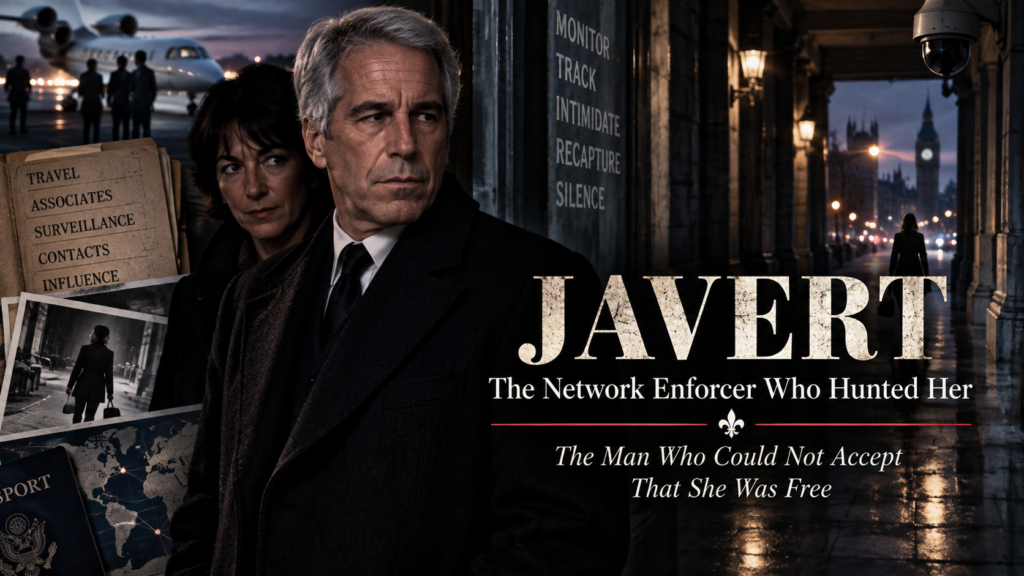
Javert — The Network Enforcer Who Hunted Her
A man inside the trafficking organization who pursued Victoria obsessively across decades, enforcing the will of the system with relentless determination. To her, his singular mission appeared to be to track, intimidate, recapture, and silence her whenever she attempted to live freely outside the control of the network.
His pursuit of Victoria embodied the cold, merciless obsession found in Hugo’s Javert, but within the landscape of modern trafficking — as he hunted her like an animal across decades —through surveillance, intimidation, retrafficking attempts, and proxy enforcement carried out both directly and through others working under him.
Like Javert in Les Misérables, he could not tolerate deviation, escape, or the idea that someone he believed belonged to the system had become free. What began as trafficking evolved into a long-term pattern of surveillance, intimidation, stalking, sabotage, retrafficking attempts, and proxy enforcement carried out both directly and through others working under him.
At times, he appeared personally during trafficking incidents and confrontations. At other times, individuals connected to the organization acted on his behalf — carrying out abductions, intimidation, monitoring, and coercion while he operated from the background. To Victoria, the pursuit often felt larger than one individual man, as though an entire system had been activated to prevent her from escaping the life they intended for her.
Even after Victoria was rescued and reunited with her family, the pursuit did not fully end. Attempts to destabilize her life continued through interference with relationships, career paths, housing, ministry environments, travel, and personal safety. Periods of freedom were repeatedly interrupted by new attempts to force her back under the influence or control of the trafficking network.
During later encounters, he reportedly made clear to Victoria that he viewed her as one of the people most dangerous to him because of the possibility that she might publicly speak about what had happened.
Known publicly as Jeffrey Epstein, his life ended in a suicide while awaiting trial.
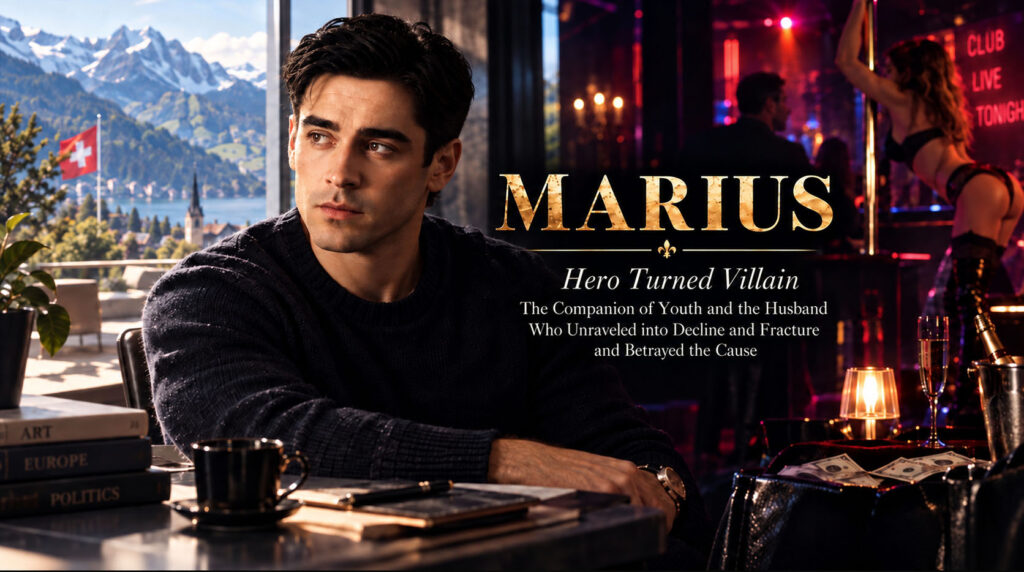
Marius — Hero Turned Villain —The Companion of Youth and the Husband Who Unraveled into Decline and Fracture and Betrayed the Cause
In Les Misérables, Marius represents youthful idealism, romance, conviction, and the longing to build a meaningful life within the midst of revolution and upheaval.
In Scotland’s Les Misérables, Marius is represented through Colin — Victoria’s former husband — the young man who initially appeared as a rescuer, companion, protector, and fellow believer standing against the forces that had consumed much of her life.
Victoria married Colin in 1996 when she was sixteen years old and he was twenty, shortly after she escaped Epstein’s child trafficking web and was rescued in Grindelwald, Switzerland.
To Victoria, Colin first appeared as a heroic figure who entered the darkness surrounding her life at a moment when escape still seemed almost impossible.
He rescued her from child trafficking when he showed up at the Thenardiers’ house in Liberty, Missouri, in 1996, disguised as a member of a Christian missions organization, and picked her up to take her to the airport to fly her to Grindelwald, Switzerland, to go on the church mission trip that saved her life. (See Article: The Faith of a Hero)
Through their teenage marriage, he became her Legal Shield, which prevented the Thenardiers from forcing her back into the environment she had escaped. They vehemently protested the allegations that they were participants in child trafficking and were actively using legal mechanisms to demand her to be returned to them. Victoria’s marriage to Colin shocked them and stopped them.
To Victoria, the marriage initially symbolized sanctuary, protection, youthful hope, shared faith, and the possibility of finally building a life with the boy she had known and loved since childhood.
Like Marius in Les Misérables, Colin originally appeared aligned with justice, faith, idealism, and moral purpose.
An Irish-born citizen of the UK, he initially shared Victoria’s Christian faith and had a passion for international missions, justice, and Scottish independence. When he rescued and married Victoria, he appeared determined to become an abolitionist of human trafficking and modern day slavery.
But within Scotland’s Les Misérables, Marius becomes a tragic figure because the revolutionary idealism that once defined him gradually fractures beneath temptation, compromise, addiction, ego, spiritual drift, and the seductive pull of the very world he once opposed.
He developed a problem with alcohol and instead defected into the world of escorts and betrayed everything he once claimed to stand for when he changed career paths to become an actor.
Originally he set out to be a Christian witness of purity and faith within the entertainment industry but diverted from that path after his agent talked him out of it.
Instead he became spiritually and morally divided by the surrounding celebrity culture involving open sexuality, escorts, infidelity, emotional instability, and alcohol abuse.
To Victoria, he appeared to become a serial adulterer with the women he worked with and appeared to treat his job like it was a form of quasi-dating.
The man who once helped rescue her increasingly became entangled with environments that mirrored aspects of the same exploitative world she had spent her life trying to escape.
To Victoria, one of the most painful aspects of this transformation was that Colin never fully seemed to understand the destruction his choices caused, why this destroyed his marriage.
He repeatedly sought reconciliation and second chances, yet each return to the relationship appeared to coincide with instability and deepening danger.
Within Scotland’s Les Misérables, Marius therefore represents more than lost romance alone.
He represents the tragedy of compromised idealism — the painful collapse of a person who once genuinely stood for justice, courage, faith, and rescue, yet gradually became spiritually fractured by the very forces he once opposed.
Unlike the openly monstrous figures within Scotland’s Les Misérables, Marius is tragic precisely because he was not originally an enemy.
He was, at one time, part of Victoria’s rescue.
That is what makes his fall so devastating.
He was once genuinely brave, genuinely loving, genuinely idealistic, and genuinely part of the rescue.
To Victoria, Marius ultimately symbolizes the heartbreaking reality that not every revolutionary spirit survives the battle unchanged. Some become exhausted. Some become divided. Some lose themselves within the systems they once resisted.
And some become tragic reminders that rescue alone is not always enough to fully escape the gravitational pull of darkness, power, addiction, and spiritual compromise.
Systems of darkness do not merely hurt people physically —they reshape people psychologically, spiritually, morally, emotionally, relationally, and socially across decades.
And Marius is the heartbreaking proof that: even rescuers are not immune to that gravitational pull.
(*The name Colin works under as an actor has not been publicly disclosed.)
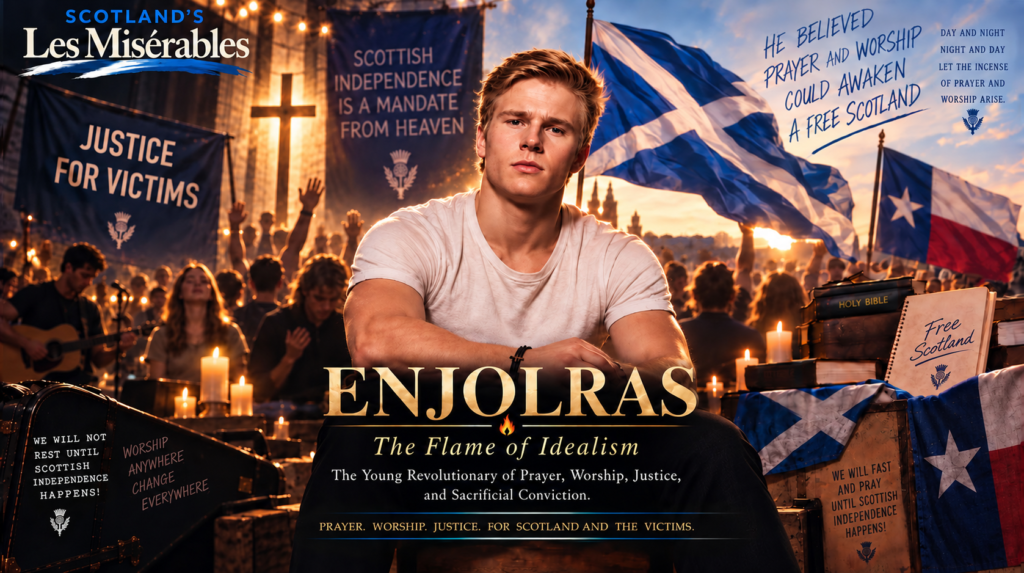
Enjolras — The Flame of Idealism
In Les Misérables, Enjolras represents youthful idealism, revolutionary conviction, courage, sacrifice, and the unwavering belief that freedom and justice are worth fighting for even at tremendous personal cost.
In Scotland’s Les Misérables, Enjolras is represented through Robbie — Colin’s closest friend and a passionate leader within a Christian student ministry and international missions movement.
Robbie embodied the same moral fire and revolutionary spirit found in Hugo’s Enjolras: charismatic, ideological, intensely devoted —a pure flame of revolution expressed through wholehearted love for God.
He stands as the embodiment of youthful conviction — the idealist who rises with clarity, courage, and purpose, expressed not merely through politics, but through 24hr prayer, worship, and the justice movement.
Robbie became, in many ways, the symbolic flame of spiritual resistance within Scotland’s Les Misérables — the type of person who genuinely believed faith should transform the world around him rather than merely exist as private belief.
He represented the spark of resistance, the moral fire that refuses to be silenced, and the uncompromising devotion to a cause greater than himself.
Like the young revolutionaries gathered behind the barricade in Les Misérables, Robbie believed deeply in the possibility of spiritual and societal transformation, even within a world overshadowed by corruption, exploitation, cynicism, and fear.
Robbie ultimately “died on the barricade” in Dallas, Texas, in 2018 during the mass casualty event connected to the Scottish independence prayer gathering (explored in greater detail in ‘The Barricade’ section of the Scotland’s Les Misérables archetypes.)
Before the event, Victoria recalls that someone reportedly gave Robbie a chilling prophetic word:
“You’re going to die for Jesus one day. That’s your purpose.”
To Victoria, this transformed Robbie’s story into something tragically symbolic — a modern reflection of the idealistic revolutionary who stands courageously at the barricade despite overwhelming danger.
His sword?
Prayer and Worship.
His death?
A martyr’s death.
Within Scotland’s Les Misérables, Enjolras represents more than youthful passion alone.
He represents sacrificial conviction, spiritual courage, unwavering faith, and the tragic beauty of people who continue believing in justice, freedom, prayer, truth, and moral resistance —unrelenting down to the very last moment, even when standing in the shadow of death itself.
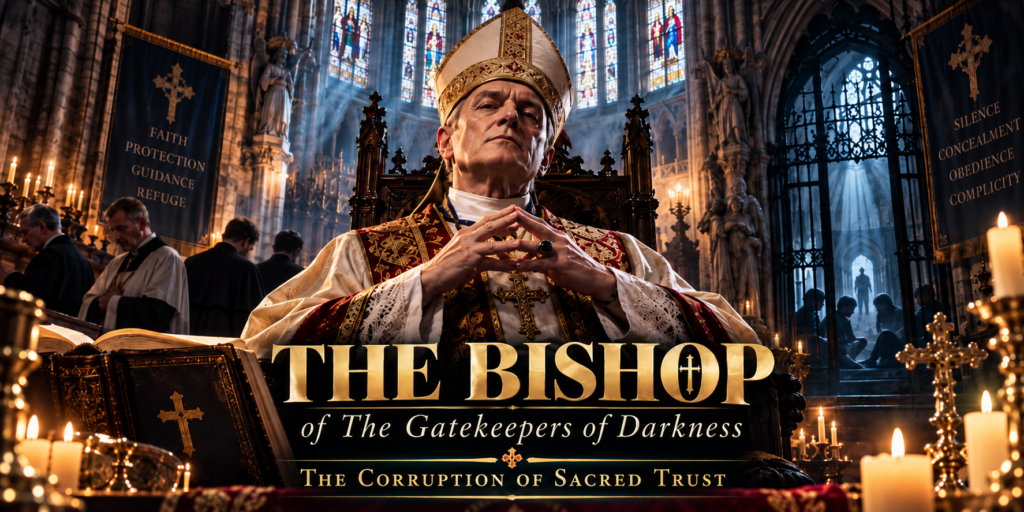
The Bishop of the Gatekeepers of Darkness vs. The House of Prayer —Corrupted Clergy vs. Spiritual Refuge
In Les Misérables, the Bishop represents mercy, moral courage, spiritual refuge, redemption, and the belief that grace can interrupt destruction. Hugo’s Bishop changes Jean Valjean’s life not through force or institutional power, but through compassion, forgiveness, and spiritual conviction.
In Scotland’s Les Misérables, however, “The Bishop” first appears as a dark inversion of that figure—as The Bishop of The Gatekeepers of Darkness.
The Bishop of The Gatekeepers of Darkness consisted of the compromised religious authority connected to Westminster Abbey and the broader institutional structures surrounding it — spiritual leaders, clergy, church volunteers and systems that failed to protect vulnerable children while corruption, exploitation, and abuse operated within environments associated with enormous public prestige, political influence, and sacred authority. Some of them actively enabled, concealed, or participated in child exploitation and human trafficking within the UK’s most iconic religious institution
To Victoria, one of the most horrifying aspects of her story was that the trafficking environment did not appear hidden in isolated criminal underworlds alone.
It became intertwined with respected institutions operating openly in public life —in her church!
The symbolic horror of The Bishop of The Gatekeepers of Darkness therefore lies in the corruption of sacred trust itself: the corruption of places that should have represented refuge, protection, truth, and moral courage into environments where silence, institutional protection, compromise, and concealment allowed abuse to continue.
In November 2024, the historic resignation of the Archbishop of Canterbury intensified public scrutiny surrounding decades of abuse allegations, institutional failures, and concealment connected to individuals operating within church environments tied to the Church of England. The scale of the revelations reinforced the disturbing realization that systems associated with immense spiritual authority had, for decades, failed many vulnerable people entrusted to their care.
Within Scotland’s Les Misérables, this institutional collapse becomes part of the symbolic inversion of Hugo’s Bishop — a religious structure outwardly associated with holiness, ceremony, and moral authority, yet spiritually and morally compromised beneath the surface.
But Scotland’s Les Misérables also contains another institutional spiritual leader — The House of Prayer.
While Victoria experienced what she viewed as corruption and spiritual betrayal within the environment surrounding Westminster, she later encountered a radically different spiritual world within the prayer movement she found in Kansas City after being trafficked there.
Through environments connected to continuous prayer, worship, fasting, and spiritual devotion — particularly the culture surrounding The International House of Prayer — Victoria encountered a form of Christianity centered not on prestige, hierarchy, or ceremony, but on night and day prayer, fasting, repentance, purity, holiness, worship, spiritual warfare, deliverance, justice for the oppressed, and the belief that God actively intervenes in human history.
To Victoria, this environment was the polar opposite of the church that enabled the child trafficking environment of which she became a victim.
The House of Prayer taught that prayer was not symbolic ritual alone, but a spiritual weapon — that worship was not performance, but active participation in spiritual conflict; that purity mattered; that heaven responded to sincere prayer; that God moves at the sound of a person’s voice, that he sends angels to break chains, opening prison doors and set captives free, and that God could create a way out where no way appeared to exist, that nothing is ever impossible with God.
Victoria recalls being transformatively impacted by The House of Prayer and the music of the prayer room culture that sang passages from the Bible and songs about pure and holy monogamous relationships of love and marriage.
To her, these teachings became spiritually transformative.
They taught her that evil was not ultimate.
That systems of power that enslaved her were not beyond God’s reach.
That prayer could confront the darkness that held her as a captive directly.
That worship could push back darkness and open a door for angels to tangibly intervene in her circumstances.
That courage and faith could interrupt the destruction she experienced, that she could even find a way back to her family.
This contrast ultimately became central to the spiritual structure of Scotland’s Les Misérables itself.
The Bishop of The Gatekeepers of Darkness represented institutional corruption, compromised authority, and sacred trust betrayed.
The House of Prayer represented spiritual refuge, moral courage, justice, prayer, mercy, deliverance, and the belief that God still moves in human history through ordinary people who genuinely choose to believe what they pray and sing, who position their hearts with holiness and purity.
To Victoria, this distinction became one of the defining realizations of her life:
that the institutions appearing most spiritually powerful were not always spiritually alive — while some of the truest spiritual refuge she ever encountered emerged through humble communities devoted to prayer, worship, repentance, and the active presence of God.
Victoria states that individuals connected to the trafficking world later blamed the prayer movement itself for why she resisted assimilation into the escort culture surrounding them. According to Victoria, they believed the culture of continual prayer, worship, purity, repentance, and spiritual devotion had fundamentally changed the way she viewed power, sexuality, relationships, identity, and human worth — making it impossible for her to embrace or psychologically normalize the world they attempted to draw her into.
This revealed how deeply incompatible the two spiritual worlds truly were. One sought to normalize exploitation, domination, grooming, and transactional intimacy. The other taught holiness, deliverance, prayer, purity, repentance, mercy, and the belief that every human being possessed sacred value before God.
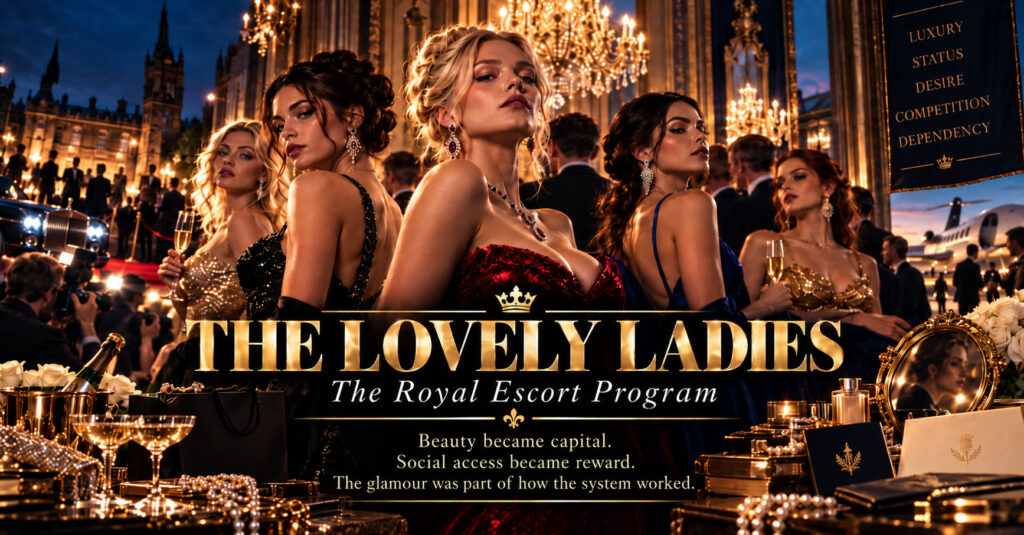
The Lovely Ladies — The Royal Escort Program
In Les Misérables, the Lovely Ladies are women shaped by poverty, exploitation, survival, and systems that slowly consume them while disguising their suffering beneath performance, beauty, and social expectation.
In Scotland’s Les Misérables, The Lovely Ladies represent the hidden world of elite escort culture surrounding aristocratic, political, celebrity, and financial circles — a world where glamour, luxury, beauty, sexuality, access, and social status often concealed deeper systems of manipulation and strange dependency.
Women connected to this world appeared publicly at royal events, elite social gatherings, parties, political circles, and celebrity environments, creating the impression of sophistication and legitimacy while concealing the emotional instability, competition and manipulation —their plastic beauty masking captivity, and survival while privately trapped in lives shaped by grooming and coercion. Some sought escape, some embraced the culture — all were caught in a system built on exploitation.
This world did not initially present itself as something dark or criminal to many of the women involved.
It presented itself as glamorous.
Many of the women appeared to view entry into the system as an opportunity for elevation into elite social circles — a path out of ordinary life and into a world of wealth, exclusivity, influence, luxury, travel, and powerful relationships.
Some of the women actively sought involvement in this environment and spoke about it as though it were a desirable career path. Working within the orbit of powerful men was often presented as aspirational, sophisticated, and prestigious rather than exploitative.
Victoria recalls hearing Jeffrey Epstein openly describe the system to groups of women in transactional and ideological terms — portraying it as a structure designed to transform “ordinary” women into socially and sexually desirable companions for elite men.
According to Victoria, Epstein described the system as one in which women would gradually become emotionally and socially attached to increasingly powerful men, until some eventually transitioned into exclusive long-term arrangements as wives, girlfriends, mistresses, concubines, or financially supported companions within elite social circles.
What made this environment especially disturbing was not only the sexuality surrounding it, but the normalization of it.
Many of the women appeared to believe they had discovered empowerment, advancement, freedom, status, romance, or opportunity. Some did not initially perceive themselves as victims at all. Over time, however, many came to view the system as one built upon emotional grooming, dependency, transactional intimacy, social conditioning, and the gradual transformation of human relationships into commodities orbiting wealth and power.
Within Scotland’s Les Misérables, The Lovely Ladies therefore represent more than escorts alone.
They symbolize the tragic human cost of systems that glamorize exploitation, normalize transactional intimacy, and use beauty, status, loneliness, ambition, romance, and desire as mechanisms of control.
Like Fantine in Les Misérables, many were not portrayed as villains, but as women who became psychologically, emotionally, socially, or financially trapped inside a world that initially appeared glamorous — until the deeper cost of belonging to it became impossible to escape.
In many ways, the emotional world surrounding the escorts highlighted in Scotland’s Les Misérables echoes the tragic themes expressed in the Lovely Ladies song “Lovely Ladies”:
“…rich men, leaders of the land…”
“…don’t they know they’re making love to one already dead?”
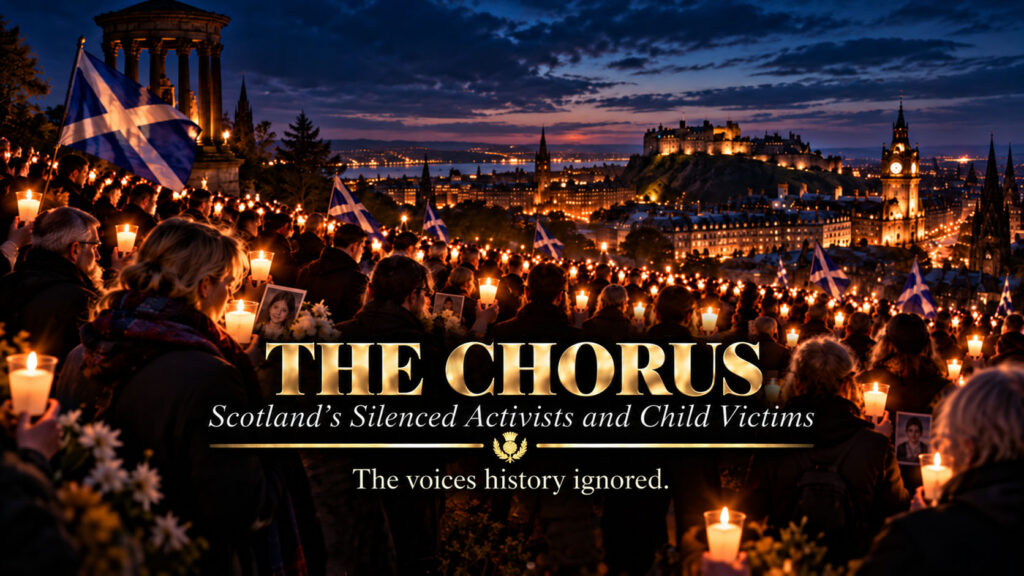
The Chorus — Scotland’s Silenced Activists and Child Victims
In Les Misérables, the chorus is the collective voice surrounding the story — the ordinary people whose suffering, hope, grief, hunger, sacrifice, and struggle form the emotional backdrop of the revolution itself.
In Scotland’s Les Misérables, The Chorus represents the many lives surrounding Victoria’s story: the trafficked children, damaged families, silenced witnesses, targeted activists, grieving parents, broken survivors, and ordinary people whose suffering never fully reached public light.
They are the children who disappeared quietly into systems of exploitation.
The families who tried to sound alarms no one wanted to hear.
The people who carried trauma for decades in silence.
The survivors who struggled to explain experiences too disturbing or unbelievable for others to easily accept.
The Chorus represents the realization that Victoria’s story was never only about herself.
Within Scotland’s Les Misérables, however, The Chorus is not primarily about headlines, public scandal, or media spectacle.
It is about the human voices beneath the headlines.
The Chorus represents the countless people whose lives were altered, damaged, silenced, or destroyed long before the public ever began to understand the scale of what survivors and investigators had been trying to describe for years: that the allegations surrounding the trafficking network reflected human destruction so enormous that some began referring to it as “crimes against humanity.”
Some members of The Chorus fought bravely for justice, truth, faith, freedom, and Scottish independence. Others were broken beneath the weight of trauma, fear, addiction, intimidation, poverty, exploitation, or hopelessness. Some survived. Many did not.
Together, they form the emotional landscape surrounding Scotland’s Les Misérables — a collective human cry rising behind the central story itself.
They include Scottish independence activists affected by systemic injustice —whose families were targeted, threatened, or harmed — and the children trafficked because of their parents’ political voices. They form the collective background of suffering and silence — a voice of hope, grief, courage, and resilience, some strengthened by struggle and others broken under its weight.
They are the unseen voices in the background of the revolution.
The voices history ignored.
The voices institutions dismissed.
They form the backdrop of suffering the public never heard, the collective voice that was never allowed to rise.
The Chorus represents all those who suffered in silence while the world continued around them — and all those whose stories still remain buried beneath fear, power, institutional protection, and time.
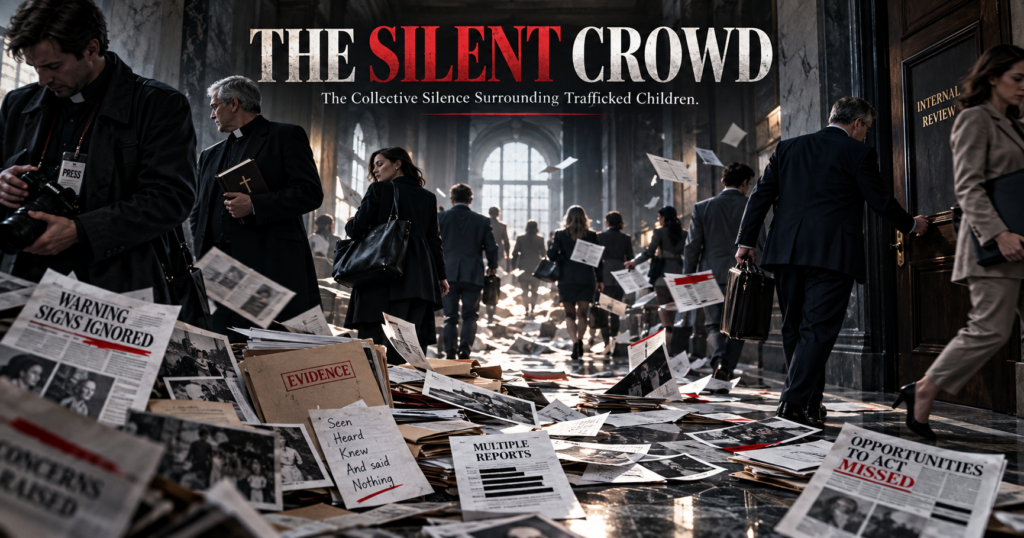
The Silent Crowd
In Scotland’s Les Misérables, The Silent Crowd represents the bystanders, institutions, professionals, organizations, and ordinary people who saw fragments of suffering, warning signs, abuse, corruption, or exploitation — yet chose not to intervene, speak publicly, or fully confront what was happening.
Unlike the direct perpetrators, The Silent Crowd often did not see themselves as evil. Many were frightened, uncertain, professionally cautious, socially self-protective, or unwilling to risk their reputations, careers, safety, or stability by confronting powerful people and disturbing allegations.
To Victoria, this silence became one of the most devastating parts of the system itself.
Again and again, family members, investigators, supporters, and others attempted to raise alarms, contact authorities, pursue investigations, or bring information to members of the media. Yet many efforts were met with hesitation, avoidance, institutional caution, or demands for impossible levels of corroboration before anyone was willing to publicly engage what was being alleged.
Some reportedly feared legal consequences. Others feared powerful individuals. Some simply did not want involvement in something that felt too disturbing, politically dangerous, socially costly, or unbelievable to confront directly.
To Victoria, these responses created the feeling that truth itself could not penetrate the system surrounding the trafficking network. Every refusal to investigate, every institution that looked away, every media organization that declined to pursue leads, and every person who chose silence rather than risk became part of the larger machinery that allowed the abuse and pursuit to continue.
The Silent Crowd therefore represents more than passive witnesses. It represents the collective silence surrounding trafficked children — the silence of neighbors, officials, church members, journalists, institutions, investigators, communities, and spectators who saw pieces of the darkness but failed to stop it.
In Les Misérables, society often watches suffering from a distance while continuing normal life around it. In Scotland’s Les Misérables, that same silence becomes part of the tragedy itself.
To Victoria, one of the most painful realizations was that evil did not survive merely because of the people committing it directly, but because so many others — for countless different reasons — chose not to fully confront it when they had the opportunity to do so.
The Silent Crowd poses a question not only to the institutions inside Scotland’s Les Misérables, but to every reader who encounters the story:
When suffering, corruption, and exploitation exist openly within powerful systems, will we remain silent — or finally refuse to look away?
The Shadow Brokers
They were the hidden facilitators, intermediaries, and power brokers who operated behind the scenes, enabling exploitation under the cover of legitimacy and status —people who used their government positions to enable and protect child trafficking schemes.
One of the shadow brokers was reportedly Peter Mandelson, also known by his colleagues as “The Prince of Darkness” —one of the names of Satan.
The shadow brokers made sure the trafficked children traveled through customs in New York City without questions. They included members of American law enforcement who refused to arrest men like Andrew Mountbatten-Windsor and others with him because they were traveling under the shield of “diplomatic immunity.”
They also reportedly included protection officers of Andrew Mountbatten-Windsor and other government connected officials who stood by with silent obedience during trafficking incidents rather than intervening.
Victoria explains they “stood like silent statues” and prevented her from leaving Epstein’s house when she was trafficked. She says as a 9 year old girl, she ran to them for help like police and cried for them to take her home—back to her family and her father. But they reportedly refused “with faces like steel” and instead supported the traffickers with ruthless obedience.
To Victoria, these moments became symbolic of the shadow brokers themselves: not always the visible perpetrators committing violence directly, but the silent institutional figures whose obedience, passivity, and loyalty to power allowed the machinery surrounding the trafficking network to continue functioning.
The Old Order — Westminster
In Scotland’s Les Misérables, “The Old Order” represents the entrenched structures of monarchy, government, aristocracy, and institutional authority that protected powerful insiders while leaving ordinary people vulnerable.
It is the world of inherited influence, elite continuity, political deference, and centralized power — systems so deeply rooted that challenging them often felt impossible from within.
The Old Order represents more than individual people. It is the inherited system itself — centralized, entrenched, institutionally protected, and difficult to confront or escape. The closer institutions became to inherited power, elite continuity, and centralized authority, the harder it became to challenge individuals protected by those same structures.
This environment created conditions where reputation, influence, institutional loyalty, and political relationships could at times override transparency and accountability. Scotland’s Les Misérables explores the belief that powerful individuals were often shielded not merely by money or status alone, but by longstanding institutional systems designed to preserve themselves.
For Victoria’s father and others who supported Scottish independence, this became deeply connected to the constitutional relationship between Scotland and Westminster itself.
To many Scottish independence supporters, the fact that Scotland could not simply authorize its own permanent referendum for independence without Westminster’s approval symbolized a deeper constitutional imbalance at the center of the union — a nation seeking sovereignty while ultimate authority remained elsewhere.
This contradiction was symbolic of The Old Order itself: systems of inherited authority so deeply established that even attempts to peacefully separate from them still required their permission.
Within Scotland’s Les Misérables, Westminster therefore becomes more than a location or political institution. It becomes a symbol of centralized power, institutional permanence, elite protection networks, and the difficulty of confronting systems that have existed for generations.
The Old Order is the world that allowed powerful individuals to operate behind prestige, status, institutional loyalty, diplomatic protection, and public image while ordinary people — especially vulnerable children — struggled to be heard, protected, or believed.
In this symbolic framework, Scotland’s struggle is not portrayed merely as a political disagreement, but as a struggle against inherited systems of power viewed as too entrenched, too protected, and too intertwined with themselves to willingly expose their own corruption.
The Hidden Victims — Children Who Never Returned
In Scotland’s Les Misérables, The Hidden Victims represent the countless children whose stories were buried, whose suffering never reached public light and whose silence forms the tragic backdrop to Victoria’s testimony.
They were unimaginably tortured, horrifically destroyed, and had their identities erased by the network, leaving few survivors. Their stories never reached the world.
They are the boys and girls who disappeared into systems of exploitation, violence, trafficking, and silence long before the world understood the scale of what was happening.
Some were trafficked across borders, hidden inside criminal networks, stripped of identity, isolated from family, and erased from public memory. Many never returned.
Their absence forms the darkest shadow.
They are the unseen children behind the story — the ones whose voices were never heard, and whose lives ended before they ever had the opportunity to tell the world what happened to them.
In Scotland’s Les Misérables, The Hidden Victims therefore represent more than missing children alone.
They represent stolen futures, erased identities, buried suffering, and the horrifying possibility that countless stories connected to the network may never be fully known.
To Victoria, this is part of what makes survival itself feel so significant and painful at the same time.
They are the reason Victoria’s survival is so significant. She returned to speak when none of them could.
The Barricade — The Walls Scotland Could Not Break
In Les Misérables, the barricade stands as a symbol of resistance — a desperate physical stand for freedom, justice, and the hope that suffering might one day be overturned. Young revolutionaries gather behind it knowing they are outnumbered, yet believing the fight itself still matters.
In Scotland’s Les Misérables, the meaning of the barricade becomes darker.
The barricade is no longer simply a symbol of resistance. It becomes a symbol of entrapment — a weaponized structure used against the very people seeking freedom, prayer, and deliverance.
The first barricade is the barricade of trafficked children — the boys and girls destroyed, silenced, and erased long before they ever had the chance to fight for their own freedom. Their suffering and lost futures created a wall the world refused to acknowledge: a hidden barricade built from stolen lives, broken identities, and trafficked children who never returned — a pain that should have forced the world to act long ago.
The second barricade is the political wall that prevented Scotland from protecting its own children. Powerful royal-government structures, institutional silence, and political pressure created an environment where investigations were obstructed, dissent was suppressed, and vulnerable people were left unprotected. This became part of the larger symbolic barricade that held Scotland captive — the reason Victoria’s father and others fought for Scottish independence and believed Scotland lacked the sovereignty necessary to fully defend its own people.
But the third barricade was the one Victoria says she physically saw with her own eyes.
In 2018, Victoria attended what was presented as a Christian prayer and worship gathering for Scottish independence in Dallas, Texas, hosted by a startup church in the city’s industrial district. The church advertised itself as being modeled after the 24/7 prayer-room culture of International House of Prayer in Kansas City — an immersive environment centered around continuous worship, prayer, intercession, and revival-style ministry.
The event initially appeared peaceful: a gathering focused on prayer, worship, and hope for Scotland’s future.
What unfolded next permanently altered her understanding of the barricade.
Victoria states that violence erupted after individuals allegedly connected to the same network that had pursued her for years turned the gathering into a trap.
She recalls the gang created a literal wall of large pieces of church furniture, chained together and stacked against the exits — to ensure no one could escape and there would be no survivors.
The shooters screamed “Flodden!” and “Culloden!” references connected to historic Scottish battles as they killed people with their faces hidden behind Guy Fawkes masks, creating a horrifying fusion of revolutionary theater, political intimidation, and violence. Songs from Les Misérables played throughout the background during the chaos that appeared to mirror the London Riots, creating additional symbolic connections.
The mass casualty event was later downplayed in the very limited and brief media coverage it received as “a gas-fire under investigation for homicides and arson,” and the full truth of what happened was never publicly explained, as officials feared copycat crimes.
To Victoria that night in Dallas, the structure resembled the barricades of Les Misérables so closely that the symbolism became psychologically overwhelming.
They were sending a message that they viewed that event, a simple prayer and worship event for Scottish independence, like it was one of the historic massacres of Scottish resistance, like they were the British army with superior weapons, and we were the Scottish army at the battle of Culloden, outnumbered without the ability to fight back and properly defend ourselves.
The event felt surreal — as though the imagery, music, and revolutionary symbolism of Les Misérables had been weaponized and inverted against the very people gathered there.
In Hugo’s story, the revolutionaries build the barricade themselves as a stand for freedom.
But in Scotland’s Les Misérables, Victoria experienced the barricade as something allegedly constructed by the pursuing force itself — not to defend liberty, but to trap people inside with no way out.
To Victoria, this inversion carried profound spiritual significance.
She describes the event as feeling like an attack not only against Scottish independence, but against prayer itself — as though the gathering had been targeted because prayer, worship, and spiritual resistance were viewed as threats to the system that had pursued her across decades.
Reflecting on the event later, Victoria said:
“They were saying, ‘You will not use prayer to overturn what we have established.’”
To her, this transformed the barricade from a political image into something much deeper: a symbol of spiritual conflict, psychological warfare, and the corruption of the very things that normally represent hope, freedom, and deliverance.
What was especially horrifying that night was that prayer became bait.
Worship became cover.
The barricade became entrapment.
And the music of Les Misérables — a story deeply associated with mercy, suffering, redemption, and freedom — became part of the psychological terror surrounding the event.
The moment Victoria saw that massive barricade — so visually identical to the barricade of Les Misérables, she said something inside of her broke, she said, “I am trapped in Les Miserables, but it’s about Scotland.”
She says she has never been the same since that day.
To Victoria, the barricade became the defining symbol of Scotland’s Les Misérables: not merely a wall built during revolution, but a modern structure representing the forces she believes sought to silence prayer, suppress freedom, weaponize fear, and ensure there would be no escape.
That night in Dallas, Victoria said she sometimes felt like she was at The Battle of the Alamo — that the church she was trapped in had become the Alamo, and that she might not make it out alive.
Many did not. People literally died on the barricade that night.
“I had thought many times about writing my survival story as a comparison to Les Miserables before this happened, but this event was the deciding moment, the straw that broke the camel’s back that compelled me to share my testimony of rescue and deliverance,” said Victoria. “I told myself that day when I was trapped in that building in Dallas, If I survive this, I am going to share my story with the world, and I am going to call it Scotland’s Les Misérables. I am going to show the world what happened.”
The Phantom — An Added Character for Scotland’s Les Miserables
Victoria was first abducted on October 31, 1989, the evening Andrew Mountbatten-Windsor launched a ship in Aberdeen, Scotland, the RMS St. Helena, at the Hall, Russell & Company shipyard.
The kidnapping occurred at a costume party on October 31, 1989, on the eve of Victoria’s ninth birthday.
The crime reportedly involved—Jeffrey Epstein, Ghislaine Maxwell, Ian Maxwell, Kevin Maxwell, and Andrew Mountbatten-Windsor. Each member of the group wore costumes from the iconic Broadway musical “The Phantom of the Opera”— one of the most haunting elements of her abduction.
“The Phantom of the Opera” officially opened in London’s West End on October, 9, 1986, at Her Majesty’s Theatre. The acclaimed musical, featuring music by Andrew Lloyd Webber, had its first preview on September 27, 1986. The original cast featured Michael Crawford as the Phantom and Sarah Brightman as Christine .
In 1989, “The Phantom of the Opera” was one of the most culturally iconic musicals in London’s West End. Andrew Mountbatten-Windsor’s brother, Prince Edward, worked for Andrew Lloyd Webber’s company The Really Useful Group as a production assistant and was thought to be connected to how the costumes were supplied for the abduction.
According to investigators, Andrew Mountbatten-Windsor reportedly called himself “The Invisible Man,” which was looked at by them as a way he may have chosen to personify himself with the characterization of The Phantom.
When the child trafficking abduction of Victoria repeated in 1996, the same people were reportedly involved, and Andrew Mountbatten-Windsor again reportedly wore the phantom mask.
When this was originally investigated, Mountbatten-Windsor’s alleged involvement was minimized, and investigators assumed actors or impersonators were at fault —not him.
In Scotland’s Les Misérables, the phantom rhetorically brings uncomfortable things to the surface: the calculated theatricality used to terrify and disorient a child; the fusion of power, spectacle, and secrecy within the trafficking network; and the mask of aristocratic respectability covering violence, exploitation, and the involvement of powerful individuals.
It’s Time For a National Reckoning
One survivor’s fight for freedom becomes a country’s call for justice.