
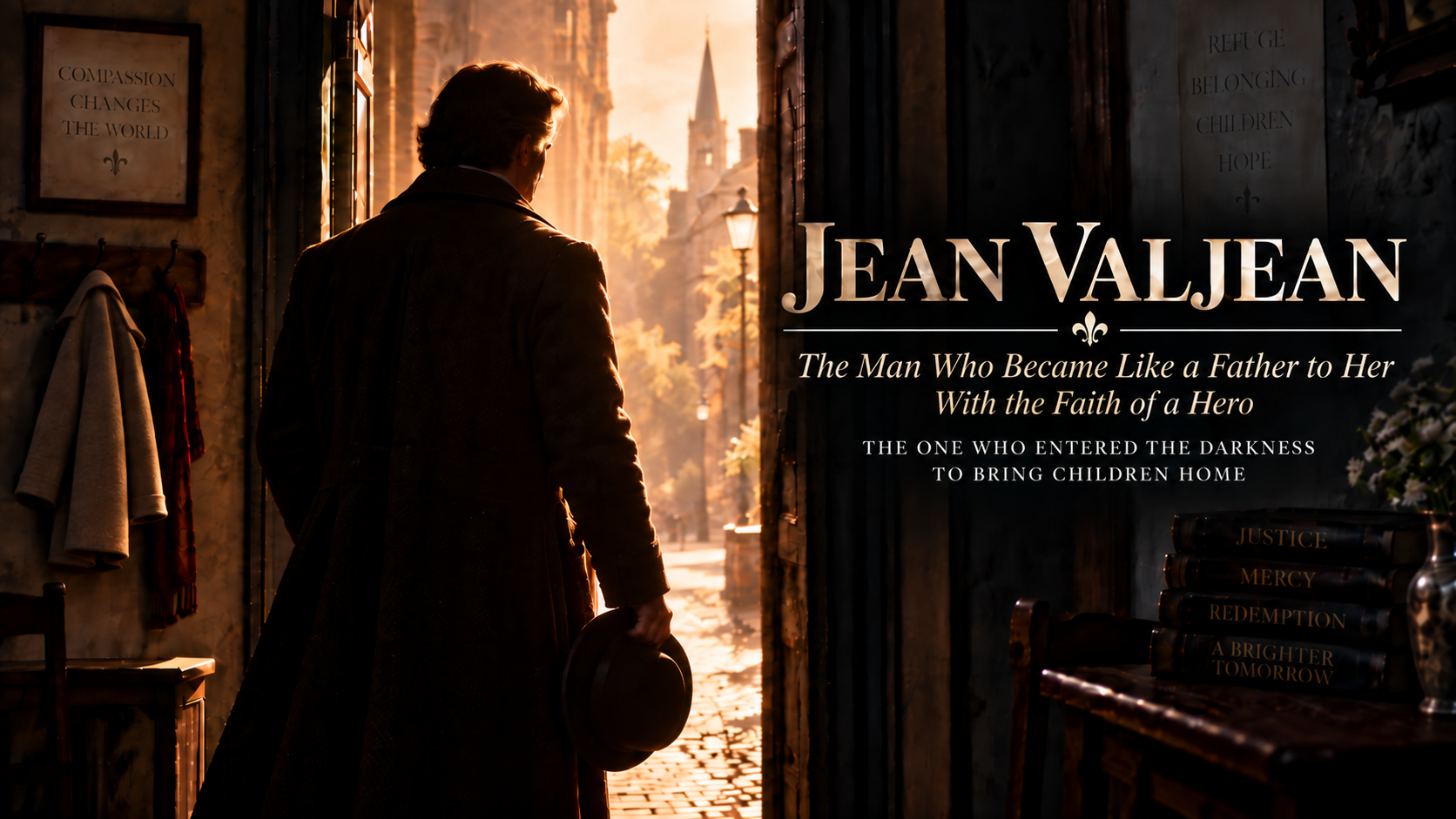
The One Who Entered The Darkness To Bring Children Home.
In Les Misérables, Jean Valjean represents redemption, sacrifice, moral courage, hidden identity, protective love, endurance, and the extraordinary transformation of a man who chooses compassion and justice after witnessing profound human suffering.
In Scotland’s Les Misérables, Jean Valjean is represented through “Joseph Cameron” — the rescuer who entered the trafficking world to recover children trapped within it and became one of the central figures in Victoria’s escape and survival.
Like Jean Valjean in Les Misérables, Joseph Cameron operated through hidden identities, secrecy, moral conviction, sacrifice, and relentless protective determination.
A British Politician Who Was Not Part Of The Systems Of Power Surrounding The Trafficking World—He Opposed Them.
To Victoria, Joseph Cameron represented one of the clearest examples of courageous moral resistance she ever encountered — a man willing to step directly into dangerous environments in order to recover children, expose trafficking systems, and protect vulnerable people despite the enormous personal risks involved.
He risked everything to locate, recover, and protect her from the network, acting with sacrificial resolve and moral conviction, stepping into danger to rescue and protect her when institutions failed. Victoria came to understand that his rescue work had resulted in him being hunted, punished, and treated as an enemy by people connected to the same world he had opposed.
According to an account Joseph shared with Victoria, he was at one point sent to work on a potato farm in Northern Ireland after interfering with trafficking operations he believed involved people connected to the British government.
He described the conditions as “forced labor” and sometimes spoke wryly about having been “a slave to the British government.” After escaping, he developed a sharp interest in politics and, in a striking twist of fate, was even elected to a public office under a different name.
The name he used when he worked on trafficking cases, “Joseph Cameron,” itself became symbolic.
Before he became known as “Joseph Cameron,” Victoria’s rescuer had used a different alias for the second identity he used while helping recover children from trafficking situations. He adopted the name “Joseph” when he rescued one of the trafficked boys held alongside Victoria, a four-year-old French child named Joseph — the child represented through Gavroche in Scotland’s Les Misérables.
The child’s suffering and then rescue profoundly impacted Victoria’s rescuer.
The name “Joseph” now marked a victory.
The child had been found.
He had been rescued.
And the name Joseph became a vow that the work of bringing other children home would continue.
To Victoria, this reflected one of the deepest characteristics of Jean Valjean himself.
He Carried The Suffering Of Others Personally.
Joseph Cameron did not appear motivated by wealth, status, institutional power, or personal advancement.
He appeared driven by conscience, protective love, moral responsibility, justice, and faith.
Within Scotland’s Les Misérables, Jean Valjean therefore becomes more than a rescuer alone.
He represents the people who willingly enter darkness in order to bring others out of it.
The people who carry burdens that are not originally their own.
The people who continue fighting long after the emotional cost becomes overwhelming.
The people who choose responsibility when it would be safer to walk away.
Like Jean Valjean carrying Cosette through the darkness in Les Misérables, Joseph Cameron became part of Victoria’s escape from the trafficking world itself.
When Victoria was fifteen years old and trapped inside the Thenardiers’ environment, Joseph Cameron helped orchestrate her removal from the house through a carefully planned rescue operation connected to a Christian missions trip to Grindelwald, Switzerland.
Following Joseph’s command, Victoria’s future husband Colin and his friend Robbie arrived at the Thenardiers’ house disguised as members of a Christian missions organization to retrieve her and bring her to the airport, where the journey that ultimately severed her from the trafficking environment began.
To Victoria, this became one of the defining moments of her life:
the moment someone entered the darkness surrounding her and helped carry her out of it.
Shortly after she arrived safely in Switzerland, Joseph temporarily became her legal guardian and, was sometimes like a father to her.
But like Jean Valjean in Les Misérables, rescue did not erase suffering.
The Scars Of The Trafficking System Continued Across Decades.
Psychologically, emotionally, spiritually, relationally, and socially, the scars of the trafficking system continued across decades —affecting survivors, rescuers, marriages, families, and entire communities long after the immediate danger appeared to end.
While “Joseph Cameron” was holding public office, Victoria understood that his hidden rescue work had become a source of increasing danger. She was informed by Joseph’s political advisors that Epstein, and his associates had become aware of his secret identity and his involvement in efforts to rescue her and other children. According to Victoria’s understanding at the time, threats followed that accusations of misconduct in public office could be used to destroy his career, damage his name, and potentially send him to prison.
Then, after the Scottish Referendum in 2014, Victoria received a goodbye email purportedly from Joseph. Against the background of the threats she had previously been told about, she understood the message as indicating that Joseph was cutting off communication while facing serious pressure surrounding his public career.
The email stated, “whatever help, support, resources or attention you would have received from me, you must now receive from God alone.”
The email shocked Victoria and threw her life into an immediate state of panic and uncertainty. What had once felt like a source of protection and stability suddenly seemed to disappear, leaving her struggling to understand what was happening and what would happen next.
Survival Is Not The Same Thing As The Sustained Restoration Of A Life.
What made the experience especially painful was that many questions were never answered. The distance that followed never truly closed.
Among the concerns she remembers hearing from people in Joseph’s environment were threats that false stories could be created which included claims that she was the product of an extramarital affair, to explain why he cared so much about rescuing her.
Victoria was told that Joseph’s political advisers sometimes feared his relationship with her as her rescuer could be deliberately twisted into a political scandal.
Rather than believing that Joseph had simply chosen to abandon her, she was left wondering whether he had now become a victim of the same forces he had spent years resisting.
The Defining Act Of Jean Valjean Is Not That He Was Perfect —It Is That One Act Of Rescue Changed The Course Of His Entire Life.
The story of the Jean Valjean of Scotland’s Les Misérables does not end with simple answers.
To Victoria, he was both the man who entered the darkness to rescue her and the man whose absence left one of the deepest unanswered questions of her life. His story became one of extraordinary courage intertwined with profound loss—a reminder that rescue itself can be incomplete, and that even lives transformed by sacrifice may still bear wounds that are never fully explained.
Victor Hugo’s Jean Valjean spends the remainder of his life living with the consequences of that decision. He stole a loaf of bread to save a life. His life is shaped by sacrifice, hidden identity, pursuit, love, loss, and moral responsibility.
The Jean Valjean of Scotland’s Les Misérables follows a similarly tragic arc.
The rescue itself was never the end of the story. It became the beginning of consequences that neither rescuer nor rescued would ever fully escape.