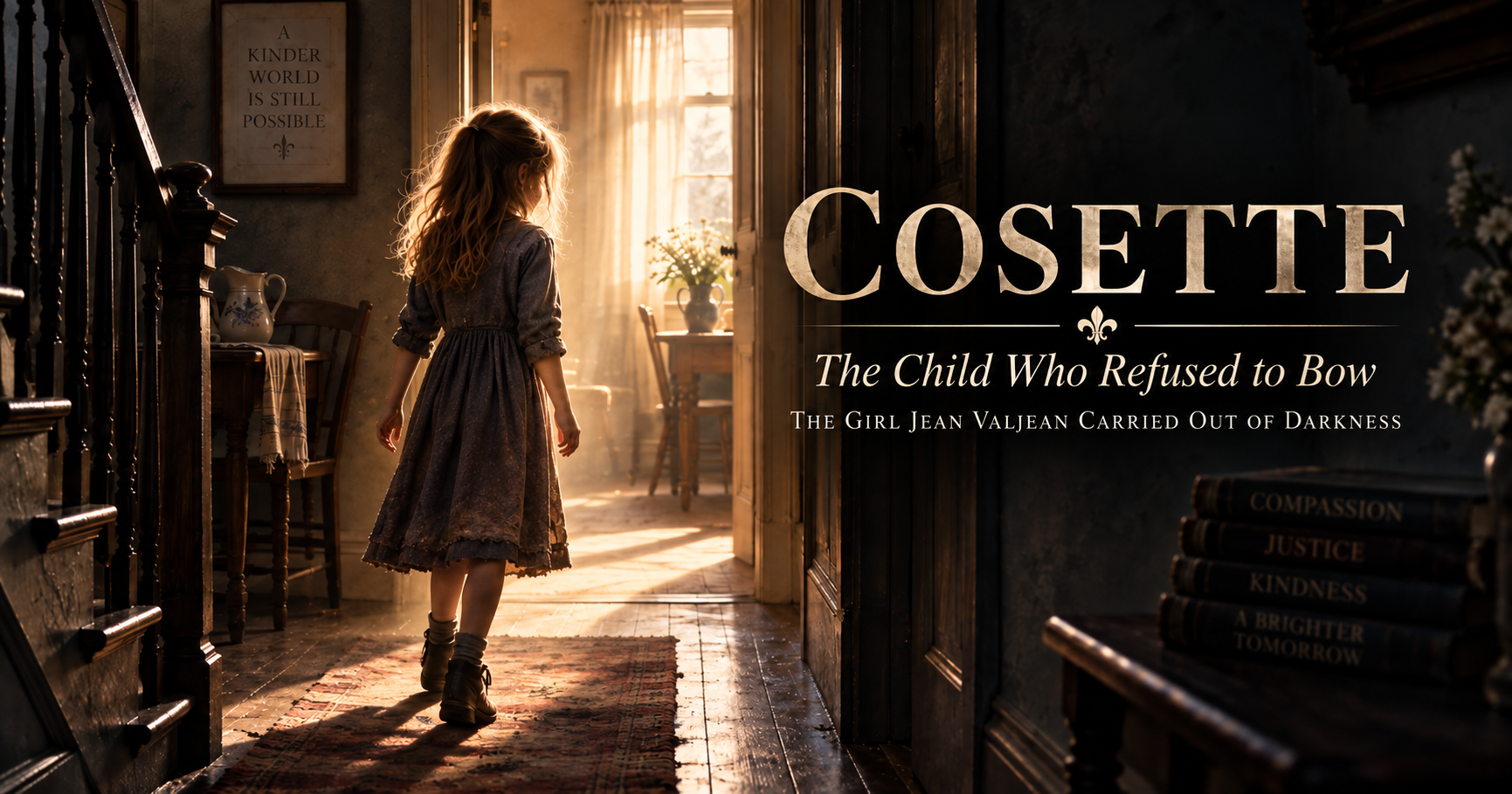
The Child Carried Out Of Darkness.
In Les Misérables, Cosette represents innocence rescued from cruelty — the child carried out of suffering and exploitation by Jean Valjean and given the opportunity to reclaim safety, dignity, identity, love, and hope after profound abuse and neglect.
In Scotland’s Les Misérables, Cosette represents Victoria herself:
the trafficked child who survived.
The girl at the heart of the story, torn from her real family, forced into the home of a violent, exploitative couple who treated her as labor and property. Like Cosette, she survived because she was rescued through divine intervention by a man who was not her biological father but became a father to her through sacrifice and action.
Trafficked by a powerful network that believed she would never escape or speak, she survived what no child should endure.
Hers Is The Voice They Never Expected To Rise.
Born an American citizen, Victoria is the daughter of a soldier in the Israel Defense Forces who was labeled an illegitimate member of the Cavendish family, one of Britain’s most powerful dynasties.
She was first trafficked in 1989 as an 8 year old girl by a network connected to Westminster Abbey that specialized in making illegitimate and inconvenient children “disappear.”
Her father, Jason Cavendish, was living in London, UK, on an assignment for the IDF investigating reports that a child trafficking ring connected to Hamas and Hezbollah had ties to associates operating out of Westminster Abbey. Victoria was child trafficked as a direct retaliation of his efforts.
She describes being trafficked as being condemned. She said, “Epstein and Maxwell were the two demons who picked me up and took me to hell.”
Like Cosette in Les Misérables, Victoria was taken into environments shaped by manipulation, exploitation, instability, fear, coercion, and psychological control long before she was old enough to fully understand the systems surrounding her.
She passed through trafficking environments connected to the Thenardiers, aristocratic circles, elite exploitation systems, organized trafficking networks, political darkness, and institutional corruption while still a child.
Like Cosette carrying the water bucket through the darkness in Les Misérables, Victoria’s childhood became defined by survival inside environments far heavier and more terrifying than any child should ever have to bear.
Within Scotland’s Les Misérables, Cosette therefore represents more than innocence alone.
She represents the child who survives systems specifically designed to erase identity, autonomy, safety, hope, and spiritual resistance itself.
The Child Who Was Never Supposed To Escape.
The child who returned alive when many others did not.
The child who carried memories too enormous for childhood itself.
This Cosette remembers the darkness she survived.
She remembers the traffickers.
The houses.
The manipulation.
The violence.
The fear.
The hidden systems.
The children who disappeared and never returned.
Yet despite prolonged exposure to the trafficking environment, Victoria refused to psychologically or spiritually assimilate into the world controlling her.
The Trafficking System Did Not Merely Seek Physical Control: It Sought Spiritual Assimilation.
It attempted to pressure her toward prostitution, promiscuity, moral compromise, spiritual surrender, and acceptance of the ideologies, relationships, values, and belief systems surrounding the trafficking world itself.
The system did not merely demand silence.
It demanded participation.
Agreement.
Internalization.
Transformation.
But no matter how many times she was retrafficked, threatened, isolated, psychologically pressured, or surrounded by exploitation, she refused to spiritually surrender herself to the world attempting to consume her.
She refused prostitution.
She refused sexual compromise.
She refused to embrace the morality of the trafficking environment.
She refused to internalize its worldview as her own.
Instead, she continually responded through prayer, fasting, worship, faith, and the belief that God would ultimately provide a way out — even if maintaining that faith placed her in danger.
This spiritual posture resembled the biblical examples found in the Book of Daniel in the Bible — Daniel and the Jewish exiles living under Babylonian captivity who refused to spiritually assimilate into the corrupt systems surrounding them despite coercion, intimidation, and the threat of death.
Like Daniel refusing to compromise his identity while living inside Babylon, Victoria refused to inwardly surrender herself to the systems surrounding her even while physically trapped within them.
Her resistance can also be compared to Shadrach, Meshach, and Abednego — the men thrown into the fiery furnace after refusing to bow before the gods of Babylon.
This became one of the deepest spiritual realities of her survival:
the refusal to bow.
The Refusal To Bow.
The refusal to spiritually conform.
The refusal to internalize corruption.
The refusal to accept exploitation as identity.
The refusal to surrender faith despite captivity, fear, intimidation, retrafficking, and prolonged psychological pressure.
Throughout every retrafficking event and every attempt to break her psychologically or spiritually, she continued trusting God to the very point of death itself.
Even while surrounded by systems attempting to normalize prostitution, promiscuity, strange spiritual ideologies, occult rituals, moral compromise, exploitation, and psychological conditioning, she continually believed God would deliver her and ultimately provide a way out.
To Victoria, survival itself was not the greatest victory.
Remaining spiritually unbroken was.
Within Scotland’s Les Misérables, Cosette therefore also represents the lifelong struggle to rebuild identity after exploitation.
To learn who she is outside the systems that attempted to reshape and control her.
To reclaim dignity after degradation.
To recover humanity after environments that reduced human beings into commodities.
To learn safety after surviving fear.
To rediscover love after manipulation.
To find spiritual refuge after profound betrayal and darkness.
Unlike some individuals shaped by the trafficking system who gradually internalized and reproduced the corruption surrounding them, Victoria refused to psychologically assimilate into the world that harmed her.
Even during periods of retrafficking and continued danger, instead of giving in and assimilating, she rescued and protected other girls trapped within the same environments.
This becomes one of the defining symbolic differences between Cosette and Éponine within Scotland’s Les Misérables:
one child gradually became shaped into the image of the darkness surrounding her,
while the other ultimately became like Jean Valjean — carrying forward rescue, protection, faith, and moral resistance instead of reproducing the corruption she survived.
Faith Ultimately Became Central To Her Survival.
Through prayer, worship, Scripture, and the spiritual refuge she later encountered within Christian ministries in America, Victoria came to believe that her survival itself was not accidental — that God had preserved her life for a reason despite the enormous darkness surrounding her story.
Like Cosette in Les Misérables, Victoria’s life became deeply shaped by the sacrificial protection of a Jean Valjean figure who entered danger in order to carry her out of it.
But unlike the fairy-tale simplicity often associated with rescue stories, Scotland’s Les Misérables insists upon a more painful reality:
survival does not magically undo trauma.
The Scars Remain.
The memories remain.
The grief remains.
The missing children remain.
The systems that created the suffering often remain.
Yet despite this, Cosette still represents hope.
Not naïve innocence untouched by suffering —
but hope that survives suffering.
The possibility that a child rescued from darkness can still build a life.
Still love.
Still create.
Still believe.
Still fight for truth.
Still reclaim identity.
Still carry light after surviving extraordinary darkness.
To Victoria, Cosette ultimately symbolizes the unbearable cost of survival — and the miraculous reality of surviving at all.