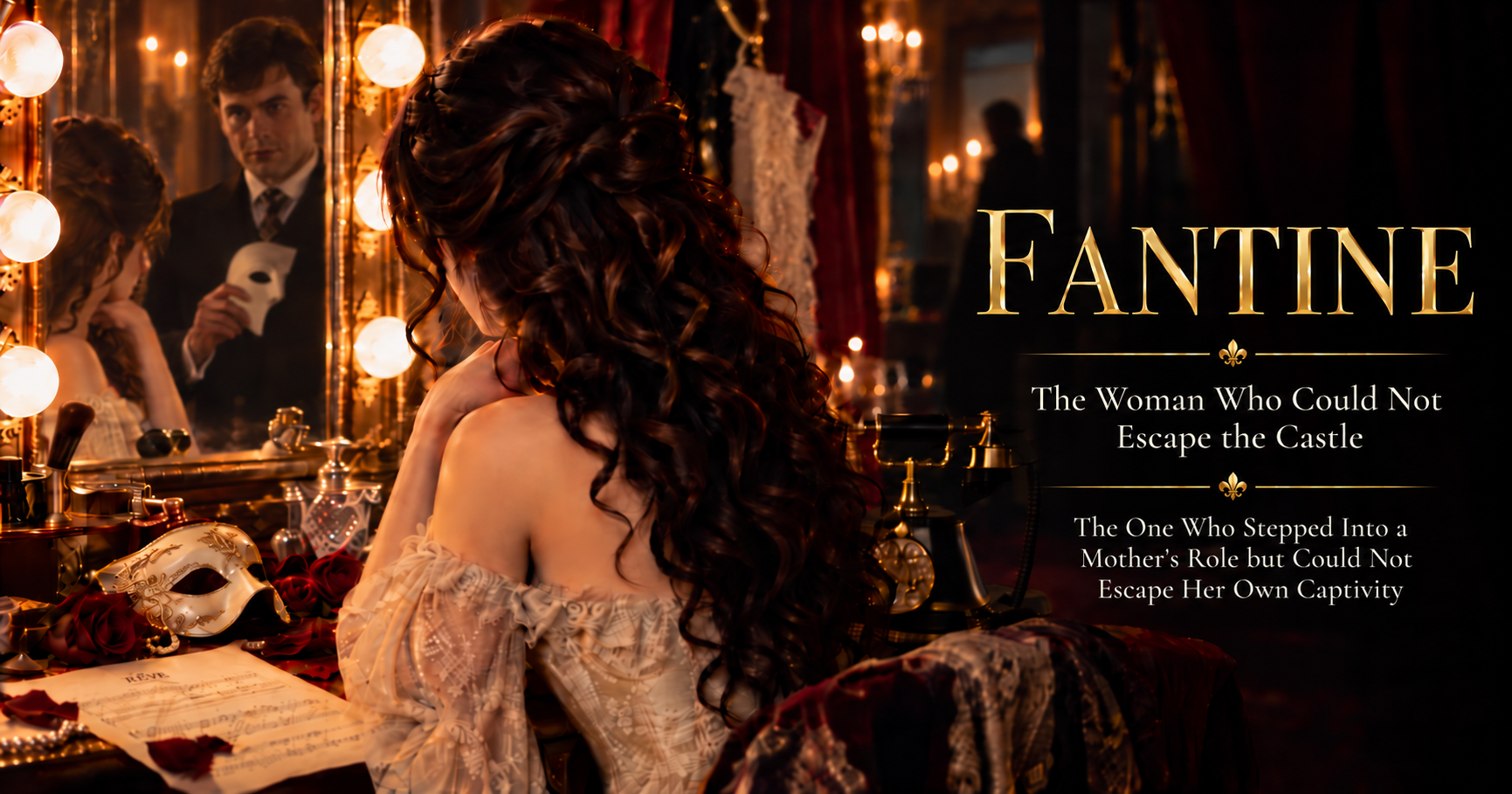
Fantine’s Story Began in the World of The Phantom of the Opera.
In Les Misérables, Fantine represents innocence consumed by survival — a beautiful and loving woman gradually destroyed by exploitation, abandonment, emotional suffering, social pressure, and systems that strip away dignity piece by piece while she desperately searches for love, security, and protection.
In Scotland’s Les Misérables, Fantine represents a talented and emotionally complex woman trapped inside the elite escort world surrounding royalty, celebrity, wealth, and power — a woman who appeared glamorous and free on the surface, yet privately lived within fear, instability, coercion, emotional captivity, and profound psychological contradiction.
Unlike Fantine in Les Misérables, this Fantine was not driven primarily by poverty.
She possessed talent, beauty, charisma, professional success, and a successful music career as a performer. She did not financially need the escort world in order to survive.
Yet despite this, she became emotionally entangled within relationships connected to aristocratic and royal power — particularly her reported relationship with Andrew Mountbatten-Windsor. She was drawn into a world of status, desire, fantasy, emotional dependency, and elite intimacy that gradually became psychologically consuming.
To Victoria, one of the most confusing aspects of Fantine was the contradiction she embodied.
At times, Fantine Spoke Desperately About Wanting To Escape The System Surrounding Her.
She described periods where she attempted to distance herself from the escort environment, avoid sexual involvement, and disappear from the reach of the powerful men connected to it.
During one of these times of wanting to escape, she began a relationship with Victoria’s uncle, while initially keeping her involvement as a royal escort a secret.
They met when her uncle took her to see The Phantom of the Opera in part to help demystify the Phantom imagery psychologically connected to her 1989 abduction. Wanting to separate theatrical symbolism from fear itself, he explained that the Phantom mask used during the trafficking event was ultimately only a stage prop connected to a musical.
He told her, “I found the source of the half white mask those people used when they took you on that trip to America. This is where that mask came from. It’s a prop from this musical. It’s nothing to be afraid of. It’s just a prop.”
After the show, he took her to meet several performers associated with the production, including the woman who would later become the Fantine archetype within Scotland’s Les Misérables. To Victoria, this later became psychologically and symbolically haunting after learning of Fantine’s reported relationship with Andrew Mountbatten-Windsor.
The woman behind the glamor.
According to Fantine’s descriptions of her reported relationship with Andrew Mountbatten-Windsor, aspects of the emotional dynamic between them resembled the relationship between the Phantom and Christine in the musical’s iconic story: obsession, seduction, emotional captivity, glamour intertwined with fear, and a powerful male figure exerting psychological and emotional control over a woman who simultaneously appeared drawn toward him and frightened by him.
To Victoria, the symbolic overlap between the theatrical story and the real-world dynamics surrounding Fantine became difficult to ignore. She explains that according to what she heard from Fantine, it seemed like the two of them were engaged in a very strange role play game.
Fantine had casually known Victoria’s mother through the musical theater world before her death, as they had both briefly worked in the musical theater industry together.
Then when in a relationship with Victoria’s uncle, seeing that Victoria had lost her mother, she sought to step into the role of a mother to her, and became, in many ways, a maternal figure to her, and at times attempted to nurture, protect, guide, and care for her in ways that emotionally resembled motherhood.
However, Victoria came to understand that she herself remained trapped inside an exploitative world she could not escape, and one Victoria’s uncle attempted to pull her out of when he came to have knowledge of it.
When Victoria’s uncle tried to free her from the royal escort system, after she confessed to participating in it and described having a very strange relationship with Andrew Mountbatten-Windsor that she had reportedly entered through that system, he said to her, “You are a concubine in a harem with a lot of other women he’s doing the same thing with.”
Yet to Victoria, Fantine remained a woman ensnared in elite exploitation, whose personal collapse reflects the human cost of systems that prey upon vulnerability, even within circles of wealth and influence.
Victoria’s uncle said about Fantine, “She’s a victim who doesn’t see herself as a victim.”
He hoped that would change.
Fantine’s suffering and entanglement with the royal escort system, including what she shared about her reported relationship with Andrew Mountbatten-Windsor, reflect how her exploitation shaped her decisions, vulnerabilities, and contradictions.
Yet even while expressing fear, emotional exhaustion, and desperation to leave, Fantine repeatedly appeared emotionally drawn back toward the very world she claimed she wanted to escape.
Victoria remembers she remained emotionally attached to Andrew Mountbatten-Windsor, and spoke flirtatiously and seductively with him when she took phone calls allegedly from him in front of Victoria. Victoria recalls she repeatedly fantasized about replacing Sarah Ferguson as Duchess of York, and appeared captivated by the emotional gravity, status, fantasy, and intimacy surrounding royal power.
To Victoria, this contradiction became deeply confusing.
Fantine simultaneously appeared:
frightened and emotionally attached,
humiliated yet devoted,
traumatized yet captivated,
trying to escape yet repeatedly returning.
Fear, Coercion, dark sexual domination, and Psychological Captivity.
Fantine privately described experiences of coercion, punishment, fear, dark sexual domination, and psychological trauma beneath the glamorous façade surrounding the escort world.
She explained that attempts to leave or refuse involvement were sometimes met with escalating intimidation, and psychological destabilization. She described traumatic sexual abuse that according to her account left her shaky and unstable for weeks, conditioning her to believe escape was impossible.
To Victoria, this revealed one of the darkest realities hidden beneath the illusion of glamorous elite relationships: many women who outwardly appeared powerful, luxurious, desired, sophisticated, and socially elevated were privately living in fear, emotional captivity, dependency, trauma bonding, and psychological fragmentation.
Yet Fantine, according to her account, continued her reported relationship with Andrew Mountbatten-Windsor in the hope that he would divorce Sarah Ferguson and marry her instead and make her The Duchess of York.
At one point, Victoria remembers she told her, “I’m really his wife, not Sarah Ferguson.”
Victoria states that when she asked Andrew Mountbatten-Windsor if he was going to marry this woman when he was in the process of divorcing Ferguson in April of 1996, he reportedly replied, “Oh no. I would never do that. There is only one Duchess of York,” like it was never even a consideration.
Fantine sometimes spoke as if she believed that through her reported relationship with Andrew Mountbatten-Windsor she could somehow protect Victoria from the trafficking system surrounding him, and talk him out of any thoughts of re-trafficking her, if they arose. She appeared convinced that her emotional closeness to powerful men gave her influence within their environment — that she could persuade, soften, or restrain the danger surrounding Victoria.
To Victoria, this became one of the tragic illusions Fantine never fully escaped:
the belief that intimacy with power could create safety from power.
At times, Fantine appeared to genuinely want motherhood, love, stability, and emotional refuge.
At other moments, Fantine made comments like, “I don’t want to be a mother because I don’t want to be chained to a child,” emotionally oscillating between longing for belonging and fear of permanent attachment.
To Victoria, Fantine ultimately embodied the devastating psychological contradictions produced by systems of exploitation:
a woman who longed for love, motherhood, freedom, protection, beauty, romance, and emotional refuge while simultaneously remaining emotionally captive to the very system destroying her.
Victoria loved many things about Fantine:
her beauty,
her talent,
her music,
her charisma,
and the humanity that still appeared within her despite the darkness surrounding her life.
But Victoria also saw the terrifying cost of the world Fantine could never fully leave behind.
Within Scotland’s Les Misérables, Fantine therefore represents more than a tragic woman alone.
Emotional Captivity Hidden Beneath Glamour.
She represents emotional captivity hidden beneath glamour: the gradual psychological destruction of a woman who outwardly appeared desired, elevated, admired, and free while privately becoming emotionally fragmented by coercion, fantasy, fear, trauma, dependency, and elite power
Like Fantine in Les Misérables, she remains heartbreaking not because she was morally imperfect, but because she appeared to contain glimpses of beauty, love, tenderness, and humanity that might have flourished differently outside the world that ultimately consumed her.
Fantine is a psychologically fragmented woman emotionally consumed by proximity to elite power while still retaining glimpses of tenderness, beauty, love, and maternal humanity beneath the damage.