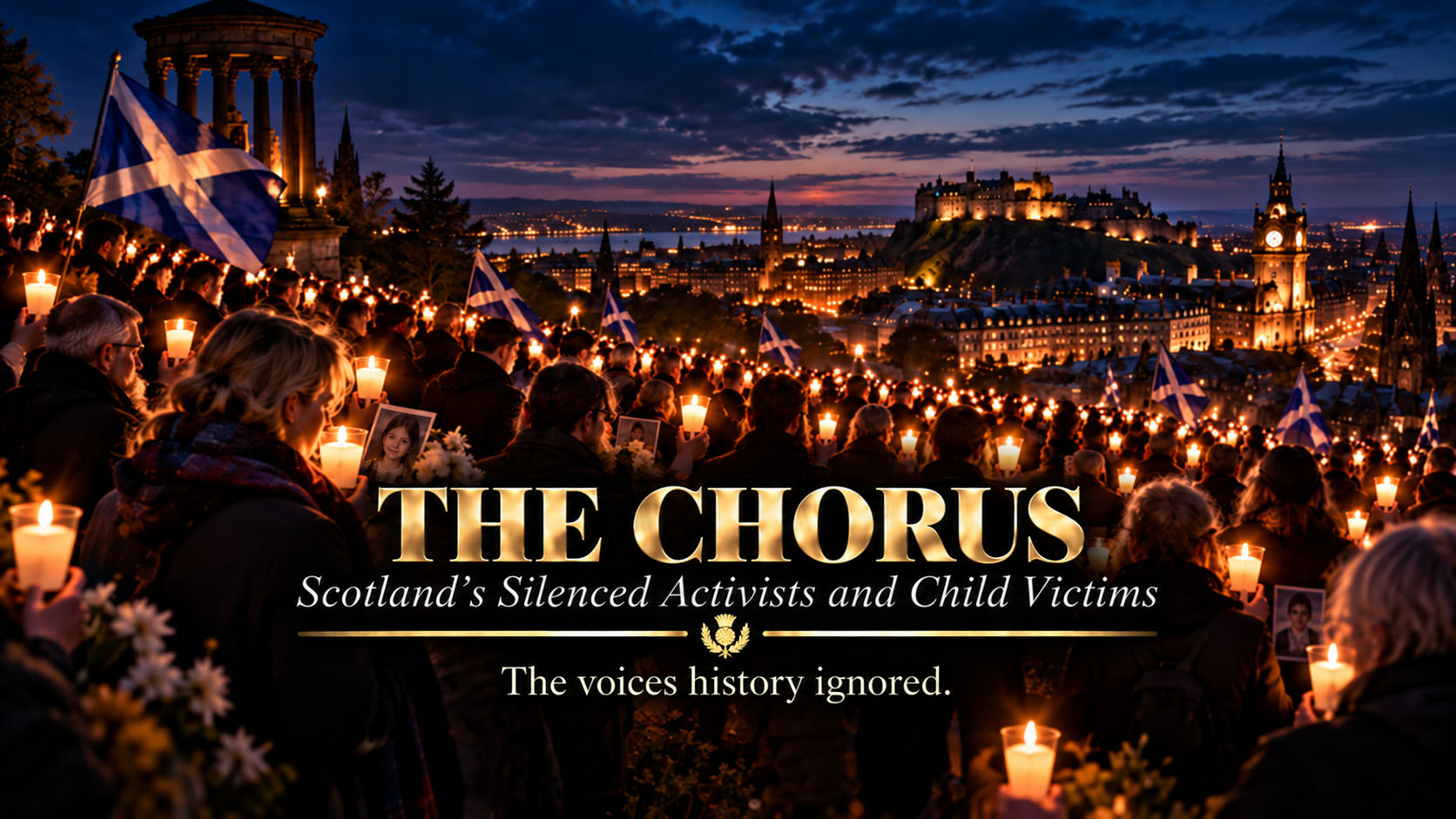
Scotland’s Silenced Voices —The Voices History Ignored.
In Les Misérables, the chorus is the collective voice surrounding the story — the ordinary people whose suffering, hope, grief, hunger, sacrifice, and struggle form the emotional backdrop of the revolution itself.
In Scotland’s Les Misérables, The Chorus represents the many lives surrounding Victoria’s story: the trafficked children, damaged families, silenced witnesses, targeted activists, grieving parents, broken survivors, and ordinary people whose suffering never fully reached public light.
They are the children who disappeared quietly into systems of exploitation.
The families who tried to sound alarms no one wanted to hear.
The people who carried trauma for decades in silence.
The survivors who struggled to explain experiences too disturbing or unbelievable for others to easily accept.
The Chorus represents the realization that Victoria’s story was never only about herself.
Within Scotland’s Les Misérables, however, The Chorus is not primarily about headlines, public scandal, or media spectacle.
It is about the human voices beneath the headlines.
The Chorus represents the countless people whose lives were altered, damaged, silenced, or destroyed long before the public ever began to understand the scale of what survivors and investigators had been trying to describe for years: that the allegations surrounding the trafficking network reflected human destruction so enormous that some began referring to it as “crimes against humanity.”
Some members of The Chorus fought bravely for justice, truth, faith, freedom, and Scottish independence. Others were broken beneath the weight of trauma, fear, addiction, intimidation, poverty, exploitation, or hopelessness. Some survived. Many did not.
Together, they form the emotional landscape surrounding Scotland’s Les Misérables — a collective human cry rising behind the central story itself.
They include Scottish independence activists affected by systemic injustice —whose families were targeted, threatened, or harmed — and the children trafficked because of their parents’ political voices.
They form the collective background of suffering and silence — a voice of hope, grief, courage, and resilience, some strengthened by struggle and others broken under its weight.
They are the unseen voices in the background of the revolution.
The voices history ignored.
The voices institutions dismissed.
They form the backdrop of suffering the public never heard, the collective voice that was never allowed to rise.
The Chorus is not background noise. It is the moral weight of the story — the accumulated grief, courage, memory, and unfinished justice carried by people whose names may never become known.
The Chorus represents all those who suffered in silence while the world continued around them: