Robbie’s Revolution: Prayer, Worship, and a Free Scotland —The Flame Behind The Movement.
In Les Misérables, Enjolras represents youthful idealism, revolutionary conviction, courage, sacrifice, and the unwavering belief that freedom and justice are worth fighting for even at tremendous personal cost.
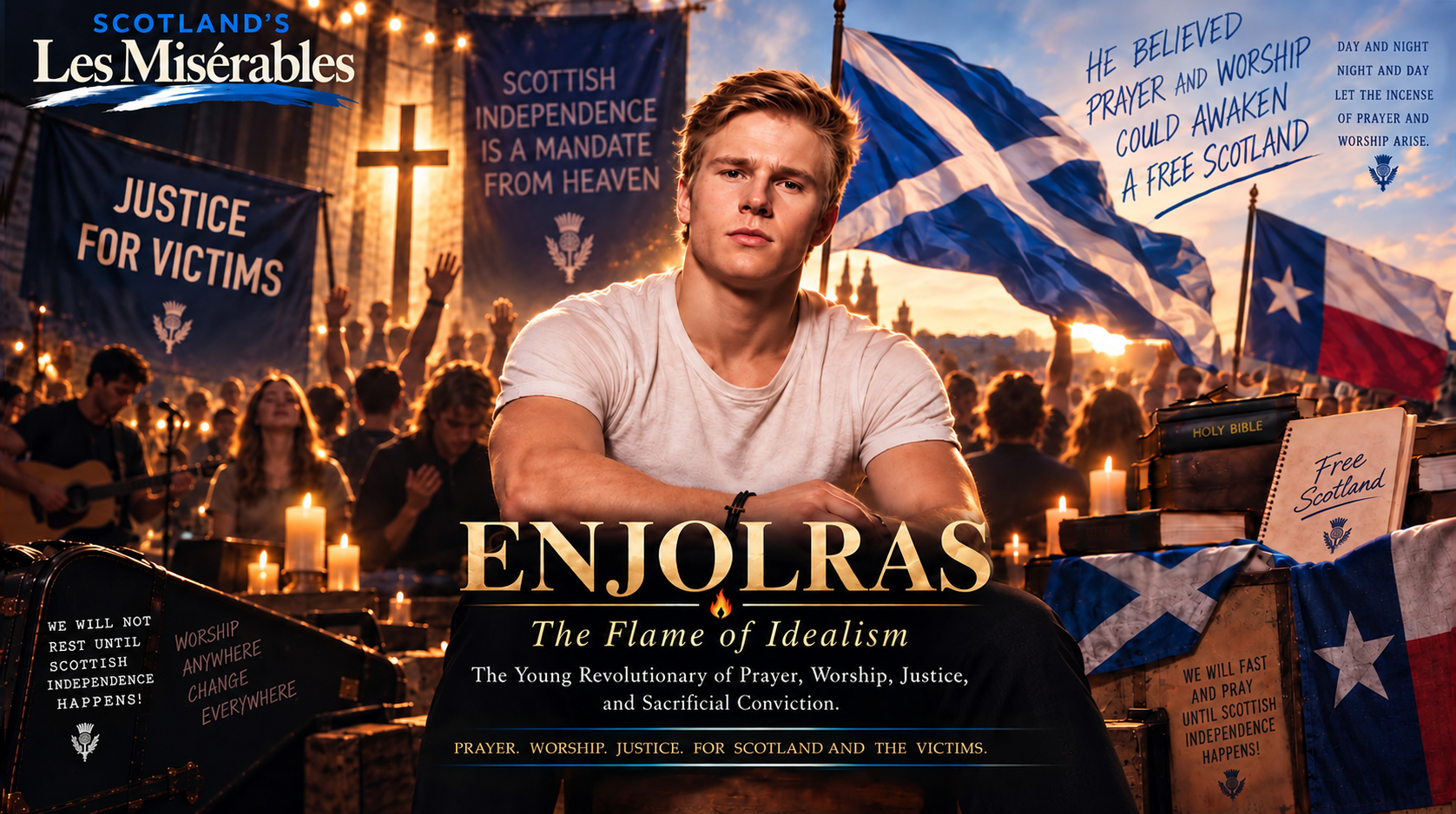
In Scotland’s Les Misérables, Enjolras is represented through Robbie — Colin’s closest friend and a passionate leader within a Christian student ministry and international missions movement.
Robbie embodied the same moral fire and revolutionary spirit found in Victor Hugo’s Enjolras: charismatic, ideological, intensely devoted —a pure flame of revolution expressed through wholehearted love for God.
He stands as the embodiment of youthful conviction — the idealist who rises with clarity, courage, and purpose, expressed not merely through politics, but through 24hr prayer, worship, and the justice movement.
Robbie became, in many ways, the symbolic flame of spiritual resistance within Scotland’s Les Misérables — the type of person who genuinely believed faith should transform the world around him rather than merely exist as private belief.
Robbie is not just the idealist who believes in justice. He is the movement-builder who believes prayer and worship can become revolutionary action.
Robbie was not simply a participant in a movement. He was a catalyst.
His revolution was built around the conviction that prayer and worship were not passive spiritual exercises, but forces capable of changing the atmosphere around a nation.
He believed sustained prayer, worship, fasting, missions, and public acts of faith could gather people around a common vision and help bring about real societal change.
In that sense, Robbie’s revolution was not made of guns and bombs. It was built from prayer rooms, worship gatherings, student ministries, missions networks, justice causes, and people willing to remain faithful to a vision larger than themselves.
Scottish independence became part of that vision.
Robbie believed a free Scotland could be awakened through a spiritual movement of revolutionary intercession— that prayer and worship could become the catalyst through which people were gathered, courage was strengthened, and national transformation could begin.
He therefore represents not only revolutionary conviction, but revolutionary intercession: the belief that spiritual devotion can become collective action, and that a movement can begin with people praying together before it ever appears in the streets.
He represents the spark of resistance, the moral fire that refuses to be silenced, and the uncompromising devotion to a cause greater than himself.
Like the young revolutionaries gathered behind the barricade in Les Misérables, Robbie believed deeply in the possibility of spiritual and societal transformation, even within a world overshadowed by corruption, exploitation, cynicism, and fear.
He Was Trying To Build A Movement — And Take It To The Church.
Robbie’s vision extended far beyond organizing individual prayer meetings for Scotland.
He had absorbed the culture of prophetic worship, fasting, intercession, and movement-building associated with The International House of Prayer and other ministries within the wider charismatic and prophetic Christian world.
Robbie followed those ministries closely, and Victoria recognized their influence in the conferences, prayer gatherings, worship, language, and spiritual intensity he was beginning to reproduce around the cause of Scottish independence.
But Robbie wanted to take that culture somewhere new.
He wanted Christians to understand how Scottish independence was part of their own spiritual heritage.
Victoria remembers Robbie declaring to an auditorium, “The prophetic destiny of the American Christian Church is to become a catalyst for Scottish independence!” —through unrelenting fasting, prayer, faith, intercession, worship, and a sustained cry for justice with a refusal to be silenced.
He believed Christians should continue contending until freedom came.
Robbie declared, “We will fast and pray until Scottish independence happens!”
He described Scottish independence as part of what he understood to be the prophetic destiny of the Church.
Victoria remembers watching him stand before a crowd with a microphone and declare:
“Scottish independence is a mandate from heaven!”
He connected Scotland to the Christian heritage surrounding Saint Andrew and encouraged Christians to see Scotland’s freedom as something belonging within their own spiritual inheritance, a nation just as important to Israel, founded on 24/7 prayer by a disciple of Jesus.
His ambitions were not small.
Robbie envisioned crowds.
He envisioned conferences.
He envisioned stadiums across America filling with intercessors for Scottish independence, gatherings reaching Christians around the world.
He wanted Scottish independence to become a cause that the international Church understood, prayed for, and carried.
And he was beginning to develop a specific next step.
The Conference He Never Got To Give.
Robbie wanted to organize a major Christian conference bringing together Scottish independence, prayer and worship, the prophetic responsibility he believed belonged to the American Church, and the fight against child trafficking.
And he wanted Victoria to tell her story.
When Robbie saw Victoria at the gathering that would later become the Dallas church massacre, he told her that he had been talking with people and receiving feedback about the movement he was trying to people. He told her people were getting excited.
He wanted her to come forward publicly and tell Christians how she had been trafficked from The United Kingdom and how she had eventually been rescued.
Robbie believed that when Christians understood what had happened to her, they would better understand why Scotland’s freedom mattered.
Within Robbie’s prophetic understanding, Victoria’s trafficking story was not disconnected from Scotland’s history.
He believed the same kinds of spiritual forces he associated with Scotland’s historic oppression, defeats, and loss of freedom, principalities the Bible speaks of, were drawing power from and manifesting themselves through modern injustice and exploitation in Scotland.
To Robbie, exposing child trafficking before the Church was therefore part of exposing why the struggle for freedom still mattered.
He wanted Christians to hear the story.
He wanted them to understand.
He wanted them to pray.
He wanted them to fast.
He wanted them to intercede.
He wanted them to cry out for justice.
He wanted them to refuse to be silenced.
And he wanted that cry to grow into a movement capable of filling churches, conferences, and stadiums.
There was already momentum and excitement building around what Robbie hoped to create.
But he never gave that conference.
Before the vision could reach the next stage Robbie had been preparing for, his life came to a sudden and violent end at The Dallas Church Massacre—the event represented in Scotland’s Les Misérables as The Barricade.
The momentum he had been building seemed to die with him. But perhaps the vision itself did not.
Sparks can ignite beneath the ashes.
And something that appeared to end at the barricade may yet rise again.
What happened to Robbie?
Robbie ultimately died on the barricade in Dallas, Texas, in 2018 during the mass casualty event connected to the Scottish independence prayer gathering, that Victoria calls “The Dallas Church Massacre.” The barricade that night was a literal barricade of furniture that a gang wearing Guy Fawkes masks had piled in front of the exits before they padlocked the doors shut from the outside and opened fire.
Before the event that resulted in his death, Colin gave Robbie a chilling prophetic word:
“You’re going to die for Jesus one day. That’s your purpose.”
To Victoria, this transformed Robbie’s story into something tragically symbolic — a modern reflection of the idealistic revolutionary who stands courageously at the barricade despite overwhelming danger.
His sword?
Prayer and Worship.
His death?
A martyr’s death.
Within Scotland’s Les Misérables, Enjolras represents more than youthful passion alone.
He represents sacrificial conviction, spiritual courage, unwavering faith, and the tragic beauty of people who continue believing in justice, freedom, prayer, truth, and moral resistance