Where Sacred Authority Became a Shield for Exploitation: The Corruption of Sacred Trust.
In Les Misérables, the Bishop represents mercy, moral courage, spiritual refuge, redemption, and the belief that grace can interrupt destruction. Victor Hugo’s Bishop changes Jean Valjean’s life not through force or institutional power, but through compassion, forgiveness, and spiritual conviction.
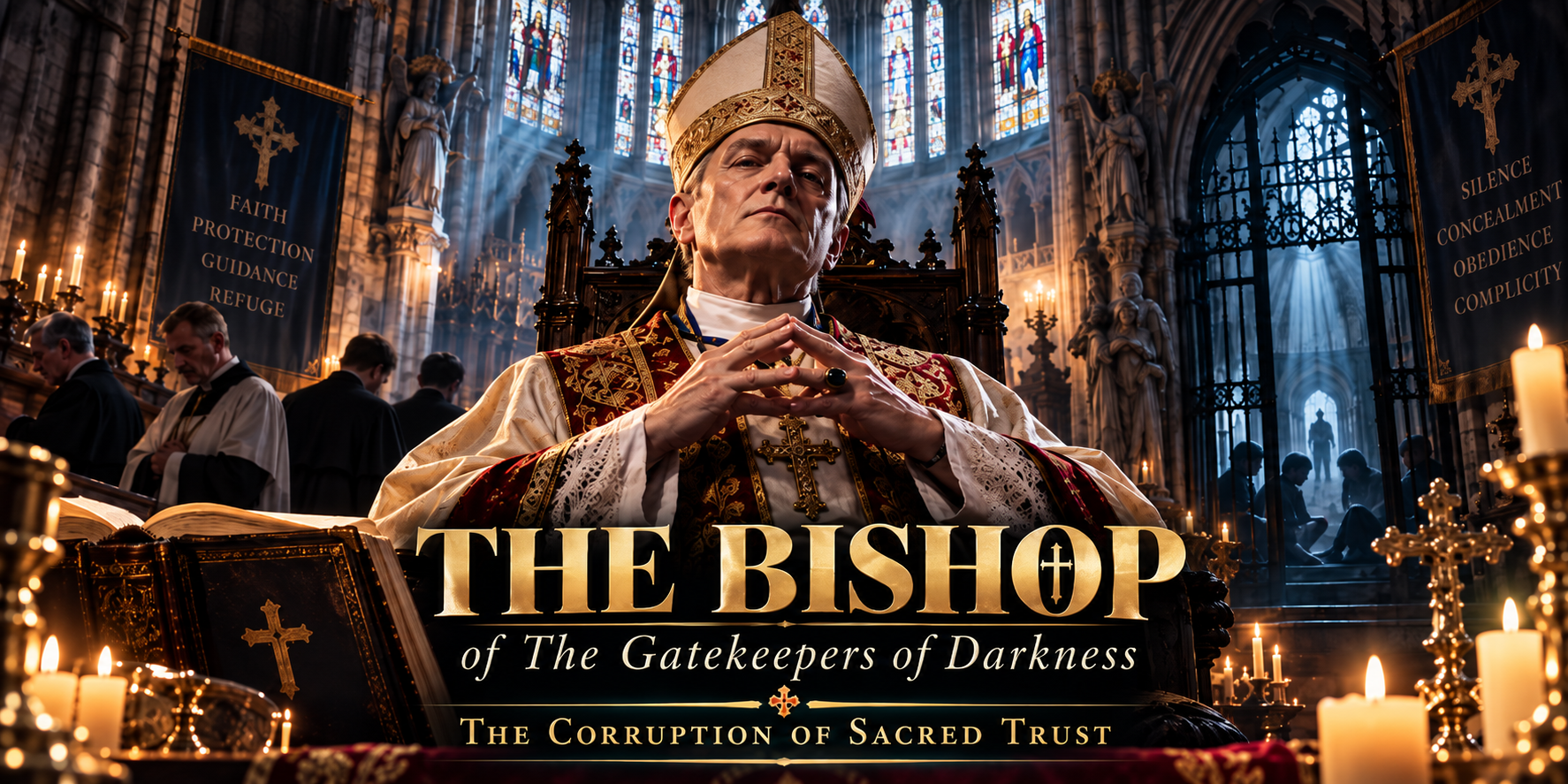
In Scotland’s Les Misérables, however, “The Bishop” appears as a dark inversion of that figure—as The Bishop of The Gatekeepers of Darkness.
The Bishop of The Gatekeepers of Darkness represents the compromised religious authority connected to Westminster Abbey and the broader institutional structures surrounding it — spiritual leaders, clergy, church volunteers, and systems that failed to protect vulnerable children while corruption, exploitation, and abuse operated inside an environment of enormous public prestige, political proximity, and sacred authority.
In Victoria’s account, some individuals connected to that religious environment actively enabled, concealed, facilitated, or participated in child exploitation and human trafficking within one of Britain’s most iconic religious institutions.
To Victoria, one of the most horrifying aspects of her story was that the trafficking environment did not appear hidden in isolated criminal underworlds alone.
It became intertwined with respected institutions operating openly in public life —in her church!
The horror of The Bishop of The Gatekeepers of Darkness therefore lies in the corruption of sacred trust itself:
The corruption of places that should have represented refuge, protection, truth, and moral courage into environments where silence, institutional protection, compromise, and concealment allowed abuse to continue.
In November 2024, the resignation of the Archbishop of Canterbury intensified international scrutiny of abuse, institutional failure, and concealment within the Church of England. The independent Makin Review documented catastrophic safeguarding failures in the handling of abuse committed by John Smyth, and Justin Welby said the review had exposed a “long-maintained conspiracy of silence.” The Church of England has since acknowledged serious institutional failures and accepted the need for major safeguarding reform. The scale of the revelations reinforced the disturbing realization that systems associated with immense spiritual authority had, for decades, failed many vulnerable people entrusted to their care.
For Scotland’s Les Misérables, however, the revelations of 2024 represented only a fracture in a much larger system finally coming into public view.
The Makin Review did not address the trafficking allegations described in Victoria’s account. Those allegations arise from Victoria’s own experiences, information communicated within her family, and the later investigation into the network surrounding what happened to her. For Scotland’s Les Misérables, the 2024 revelations are therefore presented as institutional context — not as proof of the separate trafficking allegations connected to Westminster Abbey.
The abuse scandal did not create the darkness. It exposed part of an environment in which abuse, institutional concealment, compromised authority, and the exploitation of vulnerable people had already been allowed to coexist with extraordinary religious prestige.
In Victoria’s account, the environment surrounding Westminster Abbey had already become entangled with something far darker. She describes children characterized as unwanted, illegitimate, inconvenient, or in need of placement being connected through people operating around the church to individuals involved in private adoption arrangements, exploitation, and trafficking. Victoria describes Jeffrey Epstein, Ghislaine Maxwell, and people connected to their network operated within that environment in respectable religious surroundings provided access to vulnerable families and children, while intermediaries helped make introductions and arrangements behind the appearance of ordinary church life.
According to Victoria’s account and the information later investigated around what happened to her, some children were presented as adoption placements. Others were sold. Some entered situations of sexual exploitation. She describes church-connected facilitators as helping connect adults seeking to dispose of children with people involved in those networks, with some reportedly profiting from the arrangements.
The system depended not only upon traffickers themselves, but upon gatekeepers — people whose institutional position gave them access, credibility, information, and the ability to conceal what was happening.
Victoria became one of the children caught inside that system.
”Epstein and Maxwell were the two demons who picked me up and took me to hell,” said Victoria.
Westminster Abbey had been her church. She went there with her father for worship and for the ordinary reasons a family goes to church. Yet she also remembers the fear created by certain people working within that environment: individuals she saw interacting with people connected to those who had trafficked her, people whose coldness and apparent familiarity with those networks made the church itself feel dangerous. She stayed close to her father because she did not feel safe around them.
That is what makes The Bishop of The Gatekeepers of Darkness different from an ordinary story about institutional negligence.
The danger was not simply that a church failed to notice evil occurring somewhere outside its walls.
The danger was that people inside the religious institution became part of the machinery through which vulnerable children could be identified, connected, transferred, concealed, and exploited.
A child in danger
should have been able to run toward the church.
However, in this environment, running toward the church could mean running toward people connected to the very system from which the child needed protection.
That inversion is the heart of the archetype.
Victor Hugo’s Bishop represents the sanctuary that receives the hunted person and interrupts destruction with mercy.
The Bishop of The Gatekeepers of Darkness represents the opposite: sacred authority that becomes a gate through which danger is allowed to pass.
The gatekeepers possessed what traffickers needed most — legitimacy.
A criminal operating openly looks dangerous. A criminal network operating through respected clergy, volunteers, prestigious institutions, adoption arrangements, charitable language, and connections to powerful families can appear respectable enough that outsiders do not recognize what they are seeing until enormous harm has already occurred.
This was particularly consequential in an institution connected to the Church of England, because the Church is not simply another private religious organization in Britain. It is the established church of England, with the monarch serving as its Supreme Governor and with formal constitutional connections between church and state.
The result was an extraordinary concentration of sacred prestige, social trust, political proximity, and institutional protection.
And when those forms of authority became compromised, the consequences for vulnerable children could be devastating.
Joseph Cameron later investigated what had happened and the network surrounding it. What emerged, in Victoria’s understanding of that investigation, was not merely a story of isolated predators slipping unnoticed into a church.
It was a system in which facilitators, intermediaries, compromised authority figures, and people willing to remain silent allowed exploitation to survive behind one of the most powerful symbols of Christianity in Britain.
Within Scotland’s Les Misérables, this institutional collapse becomes part of the symbolic inversion of Hugo’s Bishop — a religious structure outwardly associated with holiness, ceremony, and moral authority, yet spiritually and morally compromised beneath the surface.
That is why the public revelations of 2024 mattered so deeply.
They did not reveal everything.
But they broke open the image of institutional invulnerability.
What had been kept behind religious prestige, hierarchy, deference, and silence was finally being discussed internationally as something that could no longer simply be dismissed as impossible.
For Victoria, the revelation was not that abuse could exist within a respected church.
She already knew that.
She had lived through what happened when the gatekeepers themselves became part of the danger.
Within Scotland’s Les Misérables, The Bishop of The Gatekeepers of Darkness therefore represents more than institutional failure.
He represents the corruption of sacred trust itself.
The church should have been a place of refuge.
It should have been the place where a frightened child could run for protection.
It should have been the place where moral courage interrupted exploitation, where powerful people were confronted, where the vulnerable were defended, and where darkness was exposed rather than concealed.
Instead, when religious authority became entangled with corruption, the sanctuary itself became dangerous.
The gatekeepers who should have protected the doors became part of the system determining who was allowed through them.
The people who should have recognized exploitation could ignore it, conceal it, facilitate it, profit from it, or protect the structures that allowed it to continue.
That is the dark inversion of Hugo’s Bishop.
Bishop Myriel opens his door to Jean Valjean and changes the course of his life through mercy.
The Bishop of The Gatekeepers of Darkness closes the door on the vulnerable while allowing predators, facilitators, influence, money, and institutional power to pass freely through it.
This is what makes the archetype so disturbing.
The darkness did not survive because it remained completely hidden.
It survived because it learned how to exist inside respectable structures.
It wore religious authority.
It moved through sacred spaces.
It relied upon silence.
It benefited from prestige.
And it depended upon people who understood enough to know that something was wrong, yet chose not to become the person who stopped it.
For Victoria, Westminster Abbey was never simply the setting of what happened.
It was her church.
That is what makes the betrayal so profound.
After she became one of the children caught inside the system operating around it, the church could never represent safety in the same way again. Her family eventually left and worshipped elsewhere, because the place that should have represented sanctuary had become permanently associated with danger.
Years later, when abuse and institutional concealment within the Church of England finally began breaking into international public view, it did not feel like the beginning of the story.
It felt like part of a much older darkness finally becoming visible.
The Bishop of The Gatekeepers of Darkness stands at that threshold — between holiness and corruption, sanctuary and danger, protection and betrayal.
He represents what happens when religious authority forgets whom it was entrusted to protect.
And he stands as one of the darkest inversions in Scotland’s Les Misérables: