A 4 year old child, The son of a French Ambassador, Trafficked Out of Lebanon by Hezbollah.
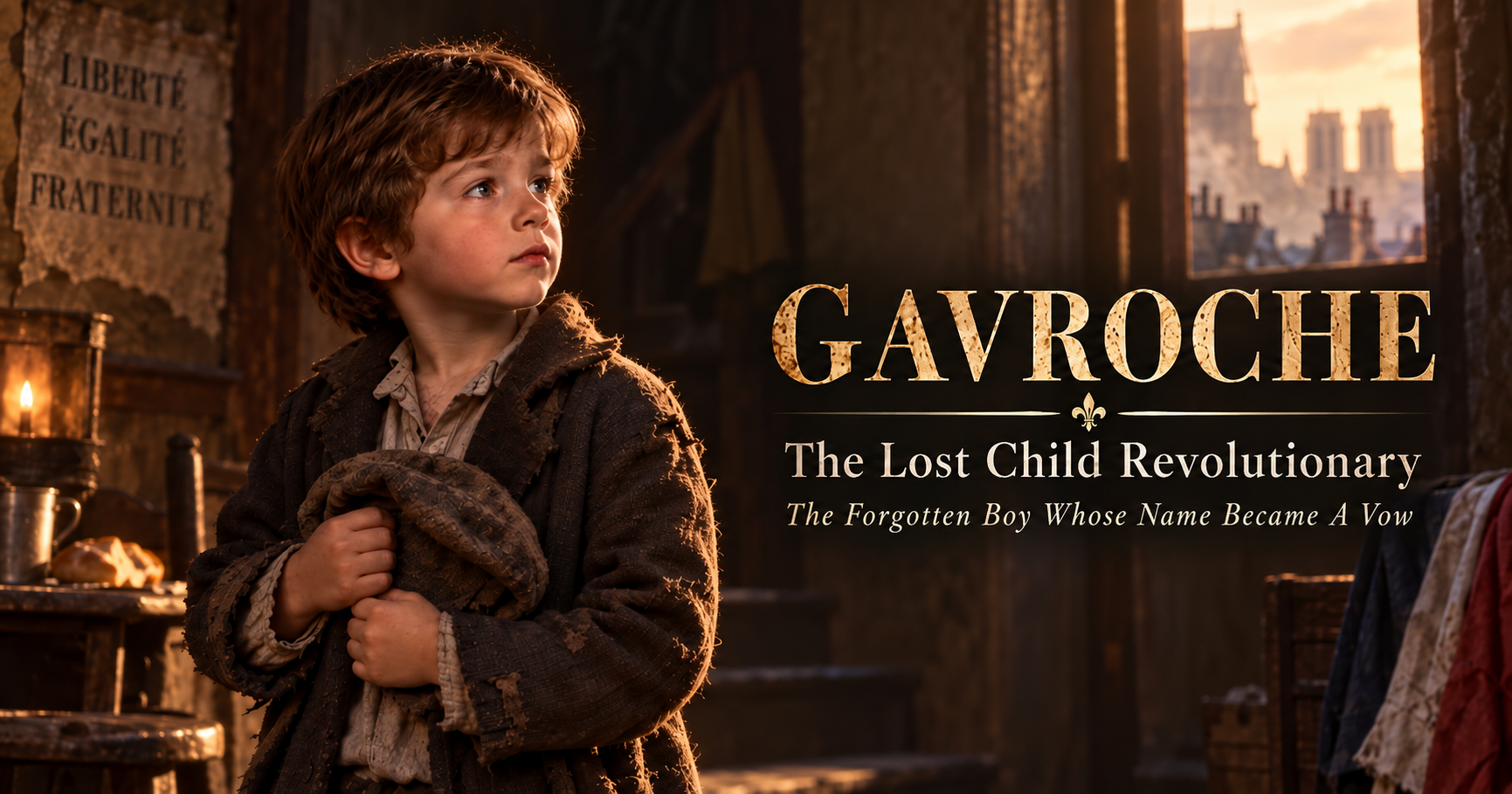
In Les Misérables, Gavroche represents the abandoned child of revolution — courageous, resilient, spirited, and tragically destroyed by a world far larger and more violent than himself.
Within Scotland’s Les Misérables, however, the Gavroche parallel does not belong entirely to one boy.
There was a Gavroche who died.
There was a Gavroche who survived.
And after them, other boys were placed into the position of the Thénardiers’ son.
The pattern surrounding the boys was disturbingly similar to what happened around the daughter-role:
the children could change,
but the position remained.
There Had Already Been A Baby
When Victoria first lived in the Thénardier household, there was an infant in the house whom Mrs. Thénardier introduced to her as her younger brother.
Mrs. Thénardier said the baby belonged to Éponine One.
When Victoria later met Éponine One, Mrs. Thénardier identified her as the baby’s mother.
She explained that Éponine One was too young to raise the child herself and would instead grow up being presented as the baby’s sister.
Victoria sometimes helped hold and care for the infant.
Then one evening, she remembers Mrs. Thénardier taking the baby outside through the back of the house toward the wooded area behind the property.
Mrs. Thénardier was wearing a long black cloak.
Victoria remembers her carrying books and a knife.
Later, Mrs. Thénardier returned without the baby.
Victoria remembers seeing what appeared to be blood on the cloak.
She asked where the baby was.
Mrs. Thénardier told her that she had “sacrificed him.”
Then she said:
“If I want a son, I can always buy another one.”
Victoria did not witness what happened outside.
She cannot independently establish what happened to the infant after Mrs. Thénardier left the house with him.
What she remembers is the baby being taken outside, Mrs. Thénardier returning without him, what appeared to be blood on her clothing, the child never returning, and what Mrs. Thénardier told her afterward.
The infant appears to have been separate from the four later boys who occupied the position of the Thénardiers’ son.
But the statement Victoria remembers hearing afterward became chilling in light of what followed.
Another boy did come.
The Gavroche Who Died
The next child was a boy Victoria personally remembers being severely abused inside the household.
Victoria remembers Mrs. Thénardier placing this boy inside a kennel-like cage in her bedroom when she left the house.
The child did not understand why.
Victoria remembers him asking:
“Why does Mommy put me in the cage?”
She remembers cigarette burns on his skin.
She also remembers a wound or marking resembling a pentagram having been burned or carved into the back of his neck.
A young mother who lived next door became concerned about the boy and shared her concerns with her husband, a Kansas City police officer. This exact status of his employment at the time is unknown.
Her own son was approximately the same age and played regularly with him, which gave her repeated opportunities to see the injuries on his body.
Victoria also personally witnessed Mrs. Thénardier sexually abusing the child.
The abuse had apparently become so normalized in his young life that he seemed to understand profoundly inappropriate sexual behavior as ordinary affection from his mother.
He spoke about “Mommy’s fur.”
He asked her to “pet her fur.”
Everything around him had taught him that what was happening was normal.
The Household Expected Him To Die
Victoria also remembers hearing that the child had AIDS.
The way adults around the household spoke about him became increasingly fatalistic.
He was discussed as though his death were inevitable.
That shaped what happened next.
Before the first Gavroche was gone, another boy was brought into the household.
The new child was spoken about as the boy who would eventually replace him.
The adults were already planning for the first boy’s death.
The replacement arrived before he died.
And the new boy was watched to determine whether he would be a suitable fit for the position of the Thénardiers’ son.
For a period of time, the two boys overlapped.
Then The First Gavroche Disappeared
Victoria did not witness the boy being killed.
At some point, the child went away with the Thenardier grandparents and Éponine One.
Éponine One later returned to the Kansas City house crying and screaming.
The boy did not return with her.
According to what Éponine One told Victoria, Mrs. Thénardier had taken a knife and cut the boy’s throat.
Éponine One said the child stopped moving after that happened.
She described his body being placed inside a trash bag and later cut into pieces.
But when Éponine One returned to the Kansas City house, she appeared profoundly traumatized and unable to fully comprehend or accept what had happened.
Victoria remembers Éponine One screaming that her mother was outside burying her brother in the ground.
She behaved as though they needed to save him.
As though they needed to get him out of the bag before it was too late.
They had this conversation in the driveway.
Victoria walked around the front yard far enough to look toward the backyard.
She saw Mrs. Thénardier digging.
There was a large trash bag beside her.
Victoria was not allowed to enter the yard.
She did not see inside the bag.
She therefore cannot personally establish what Mrs. Thénardier was burying.
What Victoria did witness was Éponine One’s terrified reaction, Mrs. Thénardier digging in the backyard with a trash bag nearby, and the boy never returning.
Within the household, the child was subsequently spoken about as dead.
His death was discussed with extraordinary callousness.
Victoria remembers the attitude being essentially that because he had AIDS and was supposedly going to die anyway, what happened to him did not matter.
This was the Gavroche who died.
Like Gavroche in Victor Hugo’s Les Misérables, he became a child destroyed by a violent world created entirely by adults.
The Gavroche Who Survived
While the first Gavroche was still alive, the replacement boy arrived.
The Kansas City house operated behind the appearance of a home babysitting service.
That meant the presence of several children at once did not automatically alarm outsiders.
Children came and went.
Multiple children could be present.
One boy could still be in the house while another was being introduced into the same family role.
The replacement child became the central Gavroche of Scotland’s Les Misérables.
He was approximately four years old in 1989.
He had brown hair.
He spoke French naturally.
He could also communicate in English.
And unlike the boy before him, he survived.
He Trusted The Girl Who Could Speak Some Of His Language
Victoria had already been learning some French and knew enough to communicate with the child in simple conversation.
The two children spoke in both English and French.
Victoria believes that shared language helped him trust her.
In an unfamiliar and frightening environment, she could understand some of his own language.
She could respond to him.
He could make himself understood to her.
And he became attached to her.
Through those conversations, Victoria learned pieces of his personal story.
But the more complicated facts surrounding his background did not come from a four-year-old attempting to explain geopolitical events.
Those facts were later investigated and confirmed by Joseph Cameron.
His Name Was Joseph
The boy’s name was Joseph.
Because of the way he pronounced his name with a French accent, some of the children heard it as something closer to “Yosef.”
They began calling him “Yosef.”
As a trafficked child, even something as basic as his name became uncertain.
A French-speaking child named Joseph became “Yosef” to children trying to understand him through accents, fragments of language, and whatever pieces of identity had survived his journey into the house.
To Victoria, this reflected one of the darkest realities of trafficking itself:
the destruction not only of a child’s safety and innocence, but of their identity, humanity, memory, and existence.
The Son Of A French Ambassador
Joseph Cameron investigated the child’s background.
He confirmed to Victoria that the boy had been trafficked out of Lebanon by Hezbollah.
He also confirmed that the child’s father was connected to French diplomatic service in a position described to Victoria as that of a French ambassador.
Victoria does not know the father’s precise diplomatic title or rank.
She does not know whether he held the singular, nationally prominent position most readers might automatically imagine when they hear the word “ambassador.”
Within international and diplomatic environments, more than one kind of French representative could be described broadly as an ambassador.
Joseph knew more about the family than he shared with Victoria.
He deliberately withheld identifying and sensitive information.
Once Joseph determined that information was off-limits, he did not later disclose it simply because Victoria continued asking.
And Victoria did ask.
She cared about what happened to the boy.
But Joseph protected the information.
The Boy’s Story Led Back To The Lebanon Hostage Crisis
If Gavroche was approximately four years old in 1989, he would have been born around 1985.
That places his infancy directly inside one of the most dangerous periods of the Lebanon Hostage Crisis.
Western nationals were being kidnapped.
French officials were among those targeted.
Diplomats, journalists, researchers, aid workers, military personnel, intelligence personnel, and other foreign nationals were operating inside an environment where ordinary distinctions between diplomacy, armed factions, underground negotiation, evacuation, and hostage-taking had become dangerously unstable.
Families were evacuated.
Personnel rotated through Beirut.
Assignments changed abruptly.
People connected to official institutions could disappear.
And children connected to those worlds could become profoundly vulnerable when the adults responsible for protecting them were themselves displaced, targeted, separated, or removed.
That was the world surrounding Gavroche’s early life.
What Happened To His Parents?
Joseph was able to establish important facts about the child.
But locating his family was much harder.
Something had happened to his parents.
At one point, Joseph did not even know whether they were still alive.
He continued searching.
Victoria was not told the details.
She was not told where the parents were.
She was not told everything Joseph learned about them.
She understood that some of the information involved matters Joseph considered sensitive enough that she was simply not permitted to know.
What she did understand was that he was trying very hard to find them.
September 19, 1990 — Gavroche Was Rescued
On Rosh Hashanah, September 19, 1990, when Joseph Cameron came to remove Victoria from the traffickers’ house, he did not remove Victoria alone—he removed Gavroche too.
The boy was immediately placed into foster care.
Joseph continued trying to locate his family.
Victoria repeatedly asked what had happened to him because she had become attached to the boy.
Joseph would not tell her where he had been placed.
He would not disclose information that could compromise his safety.
Eventually, however, Joseph told Victoria that the situation had been resolved.
The boy had been reunited with his family.
Victoria was never told who they were.
She was not told where they lived.
She was not told how the reunion was accomplished.
Joseph had decided those details were not hers to know.
But he did tell her enough to know that the child’s story had ended differently from the boy who came before him.
Gavroche got out.
And eventually, he got home.
The Name Joseph Became A Vow
The child’s suffering profoundly affected one of Victoria’s rescuers, “Joseph Cameron,” the Jean Valjean of Scotland’s Les Misérables.
But “Joseph Cameron” had not always used that name.
Before encountering this child, he had operated under another alias as part of the second identity he used in connection with trafficking cases.
After the French-speaking boy named Joseph entered the story, that changed.
He adopted Joseph as the first name of that working identity.
The alias became Joseph Cameron.
To Victoria, taking the child’s name was not an arbitrary change.
He wore the name Joseph like a badge.
A reminder.
And a vow of justice for the child.
He carried Joseph’s name forward into the work of bringing other children home.
After Gavroche — The Son-Role Continued
The surviving Gavroche was removed from the household and ultimately reunited with his family.
But the position of the Thénardiers’ son did not disappear.
Later, other boys were placed into it.
The next known chapter involved twins.
The Twins
Victoria later understood that two twin brothers became connected to the Thénardier household through some form of criminal dealing involving Mr. Thénardier and another group.
The exact transaction remains unclear to her.
The boys had been living with their grandmother.
By the time Victoria was forcibly trafficked back into the Thénardier household in 1996, one of the twins was living there in the position of the Thénardiers’ son.
The other twin was living with grandparents.
Victoria never remembers seeing both twins together in the Thénardier house.
That distinction became important years later.
One Brother Said Goodbye
According to information Victoria later learned from surveillance connected to Éponine Two, one of the twins eventually met Éponine Two at the café inside Barnes & Noble on the Country Club Plaza in Kansas City.
Éponine Two believed this boy was her brother.
According to the account preserved from that conversation, he told her goodbye.
He said things had happened inside the household and that he had spoken to the father of one of his friends, who was a Kansas City police officer.
He told Éponine Two that he was being removed from the family and entering the witness protection program.
She would never see him again.
Then he told her something extraordinary.
He had a twin.
And from that point forward, the brother she saw at the family house would not be him.
It would be the other twin.
He attempted to prepare her for the substitution by explaining the differences between them.
He told her that he himself was much more serious about athletics.
His twin was heavier.
His twin was lazier.
His twin had distinctive habits and mannerisms, including playing with a straw in his hand.
He was giving Éponine Two a way to recognize that the boy she encountered afterward was not him.
Éponine Two later contacted her friend again after returning to the Thénardier house.
She said something was strange.
Her “brother” was acting differently.
At the time, she appears not to have fully understood what had happened.
But the twins were known to exist.
And according to the account Victoria later learned, one brother had warned her in advance that the other was about to take his place. It had been hidden from her that her brother was a set of twins until that moment.
The Twin Who Remained Became Involved In The Household
By 2016, Victoria encountered the twin who remained associated with the Thénardiers during another period when traffickers had forced her back into the house.
One night, Victoria saw the twin and Mrs. Thénardier carrying large black bags from the garage, through the house, and into the backyard.
The bags appeared to Victoria to resemble body bags.
They were stiff, full, and heavy enough that Mrs. Thénardier and the twin carried them together, one person holding each end.
Victoria remembers them referring to the first bag as “Brandon.”
As they maneuvered it toward the backyard, they spoke about it as though Brandon were a person.
They told one another to be careful with him.
They placed the bag near a tree in the backyard.
They then returned for another black bag.
This one was somewhat smaller.
Victoria remembers them calling it “Kristen.”
They carried it outside in the same manner.
A third bag was considerably larger.
They called this one “Aaron.”
Again, they carried it from the garage, through the house, and into the backyard.
Victoria remembers a strong odor that she associated with dead bodies.
She did not open any of the bags and cannot independently establish what was inside them.
“It’s Just Fertilizer.”
The twin realized that Victoria had seen what they were doing.
Afterward, he took her into the garage and showed her dirt inside the trunk of the car.
He told her that he and Mrs. Thénardier had driven to a farm to collect manure, which they fertilizer, and was also referred to as “cow poop.”
He insisted that the black bags Victoria had seen contained nothing more than “cow poop.”
According to his explanation, they were not simply spreading it across the yard.
They needed to dig into the ground near the tree and bury the fertilizer around its roots because the tree needed nourishment.
They were, he said, only trying to save the tree.
He then gave Victoria several reasons why she was not allowed outside while they did it.
Animals had been coming out of the woods at night.
She could be frightened.
She could be bitten.
And the fertilizer smelled so bad that it could make her sick or cause her to vomit.
He told Victoria that Mrs. Thénardier had become sick the last time they had put fertilizer into the ground that way and had vomited.
He said he did not want the same thing to happen to Victoria.
Victoria remembers the explanation being delivered in a threatening way.
By that point, she understood that she was in severe danger.
She did not believe that the bags contained fertilizer.
She wanted them to believe that she accepted the explanation because she understood that challenging them, showing disbelief, or indicating that she believed she had witnessed something more serious could place her in even greater danger.
So she agreed.
She told them she understood that what she had seen was dirt and fertilizer.
She accepted the explanation outwardly to survive.
What Victoria Reported To Police
Victoria later reported what she had observed to the Kansas City police.
She also attempted to report that traffickers had brought her back into the household.
During that process, Victoria remembers being connected with a Kansas City police officer familiar with the Thénardier family and its long history with law enforcement.
According to Victoria’s recollection, the officer told her, in substance, that police already believed there were bodies buried on the property.
He discussed complications involved in obtaining the legal authority necessary to search and excavate the yard.
Victoria remembers being told that cadaver dogs had previously been brought onto the property.
But the dogs had detected gasoline.
That immediately connected in Victoria’s mind with something she remembers Mr. Thénardier saying openly inside the house.
According to Victoria, Mr. Thénardier had bragged that when bodies were buried in the yard, gasoline was poured over them so they would not be detected properly and the family would not be caught.
Victoria understood him to be describing a deliberate method of concealing bodies.
The officer’s response left Victoria with the impression that law enforcement had longstanding concerns about the property but believed legal and evidentiary barriers prevented them from simply excavating the yard.
Victoria cannot independently establish what searches were formally conducted, what warrants were sought, or what law-enforcement records may exist concerning those efforts.
What she remembers is what the officer told her during the call and what Mr. Thénardier had previously said in her presence.
Éponine Two Was Questioned — But She Had Been Kept In The Dark
After Victoria’s report, Éponine Two was also contacted.
After Victoria’s report, Éponine Two was also contacted. (the daughter referred to as Eponine Two in the Eponine character archetype)
The person who called her was a Kansas City police officer.
But he was presented to Éponine Two as a longtime family acquaintance or friend.
The contact was deliberately informal.
The officer called rather than bringing her into a police station because he did not want to frighten her.
He spoke with her casually about the family and asked questions about what she knew.
Did she believe the Thénardiers could be involved in trafficking?
Had she ever seen anything that concerned her?
Was there anything about the household she thought police should know?
Éponine Two reportedly said no.
The conversation nevertheless rattled her.
Before ending the call, the officer told her to keep his telephone number in her phone.
If she later remembered something, saw something unusual, or ever wanted to talk to him about the family, she could call him directly.
Éponine Two’s response was consistent with the way she had been raised.
She had been deliberately kept largely oblivious to the trafficking operation and the criminal activity surrounding the household.
She understood the Thénardiers as abusive, controlling, and dysfunctional.
She did not understand the larger criminal world Victoria had encountered inside the house.
Her answer therefore reflected how successfully Éponine Two had been kept in the dark.
Four Boys — One Son-Role
By 2016, Mr. Thénardier himself referred to four boys having occupied the position of his son.
Victoria remembers him shouting this during a telephone conversation.
He appeared to believe that Victoria could not distinguish among the different boys because she had encountered them during separate periods when traffickers had forced her back into the Thénardier household.
But Victoria remembered them.
The Gavroche who died.
The French-speaking Gavroche from Lebanon who survived.
The first twin.
The second twin.
Different boys.
One family position.
And throughout the years, the boys occupying that position were presented under the same name.
They were similar enough in appearance to sustain the role.
The child changed.
The identity surrounding the role could remain.
Even The Paperwork Could Change
Victoria remembers another incident from her childhood that later took on greater significance.
Between 1989-1990, she was present in the house while Mrs. Thénardier was speaking by telephone with a woman Victoria understood to be Ghislaine Maxwell.
The call was on speakerphone.
Victoria recognized the voice.
It was a voice she had heard before and remembers as highly distinctive — a voice she says she never wanted to hear again.
During the conversation, Victoria remembers hearing discussion about changing information on birth certificates.
According to Victoria’s recollection, the woman explained that the most effective way to make repeated changes to records was to have a contact inside the courthouse or county clerk’s office.
Victoria remembers the word “contact” being used specifically.
The contact was someone who understood why they were being approached and could repeatedly assist with requested “corrections.”
The point was not simply to walk into an office and hope that a helpful clerk would cooperate.
It was to establish a reliable contact inside the office who could be used whenever another record needed to be changed.
Once that relationship existed, discrepancies between the child and the paperwork could be presented as clerical errors.
Victoria understood the purpose of the system to be making the documents connected to the identity conform to the child occupying it.
“He’s A Boy.”
Shortly afterward, Victoria remembers Mrs. Thénardier telephoning the office responsible for one of the boys’ birth records.
Mrs. Thénardier angrily complained that the birth certificate incorrectly identified her son as female.
She became increasingly confrontational.
Victoria remembers her saying, in substance:
“He’s a boy. Do you want to see his penis? I’ll bring him over there and show you.”
Mrs. Thénardier then stormed out of the house.
Hours later, she returned triumphant.
According to what Victoria heard her say afterward, she had successfully gotten the sex listed on the child’s birth certificate changed.
She called friends and described what had happened at the clerk’s office.
Victoria remembers her speaking about other information on the document subsequently being changed as well.
From Victoria’s perspective, Mrs. Thénardier had discovered a method that worked.
A child could be placed into an existing identity.
Then discrepancies between the child and the paperwork could be presented as mistakes requiring correction.
Victoria does not know the complete history of the boys trafficked through the house and represented to others as their son.
She knows far more about what she personally saw happen to them than she does about the paperwork adults constructed around them.
The Cordova, Kentucky Record
In 2016, when Victoria was trafficked back into the Thénardier house during the events that later culminated in the trunk-of-the-car incident, she found paperwork among Mrs. Thénardier’s records identifying a boy as having been born in Cordova, Kentucky.
Victoria does not know which of the boys who occupied the son-role the document belonged to.
It may have belonged to the Gavroche who later died.
But Victoria cannot establish that.
She cannot determine whether it was another “corrected” birth certificate similar to the one she remembers Mrs. Thénardier having changed years earlier.
It could have been a later version of that record.
Or it could have belonged to an entirely different boy.
What the 2016 discovery showed Victoria was that paperwork connected to at least one of the boys had remained inside the household long after some of the children themselves were gone.
The documents and history surrounding the boys remains largely unresolved.
The Home Babysitting Service Made The Children Invisible In Plain Sight
The presence of multiple children did not necessarily alarm outsiders.
The Kansas City house operated behind the appearance of a home babysitting service.
Children came and went.
Several children could be present simultaneously.
A neighbor seeing another small child at the house therefore had an obvious explanation available:
the family cared for children.
That outward appearance helped conceal a much darker reality.
The boys did not always enter and leave in neat succession.
Their lives overlapped.
One child could still be in the house when the next arrived.
To people outside the system, it could look like ordinary childcare.
To the children inside it, identities, relationships, and family roles were being repeatedly rearranged.
Two Gavroches — Two Different Endings
In Victor Hugo’s Les Misérables, Gavroche dies amid the violence surrounding the barricade.
Within the Thénardier world Victoria encountered, there was a Gavroche who died.
One child was consumed by the violence surrounding the household.
But another Gavroche survived.
The French-speaking child from Lebanon was removed from the house on September 19, 1990.
He entered foster care.
Joseph continued searching for the family from whom he had been separated.
And eventually, Victoria was told, the boy was reunited with them.
One Gavroche died.
One Gavroche got out.
The twins who came later demonstrate that the son-role itself continued even after both boys were gone.
Within Scotland’s Les Misérables, Gavroche therefore represents more than one child alone.
He represents the forgotten children of the revolution:
the boys and girls brutalized, trafficked, renamed, substituted, silenced, and buried beneath systems far larger than themselves.
Like Gavroche standing defiantly on the barricade in Les Misérables, these children were small figures trapped inside enormous forces of violence and upheaval they could never have been expected to fight alone.
One Gavroche died.
One Gavroche survived.
The first became another child whose life was consumed by the system.
The second was carried out of it on September 19, 1990, placed into safety, and ultimately reunited with the family from whom he had been taken.
Their different endings reveal both sides of the Gavroche story:
what happens when no one reaches the child in time —
and what can happen when someone does.
To Victoria, Gavroche ultimately symbolizes the unbearable tragedy of stolen childhood itself: