
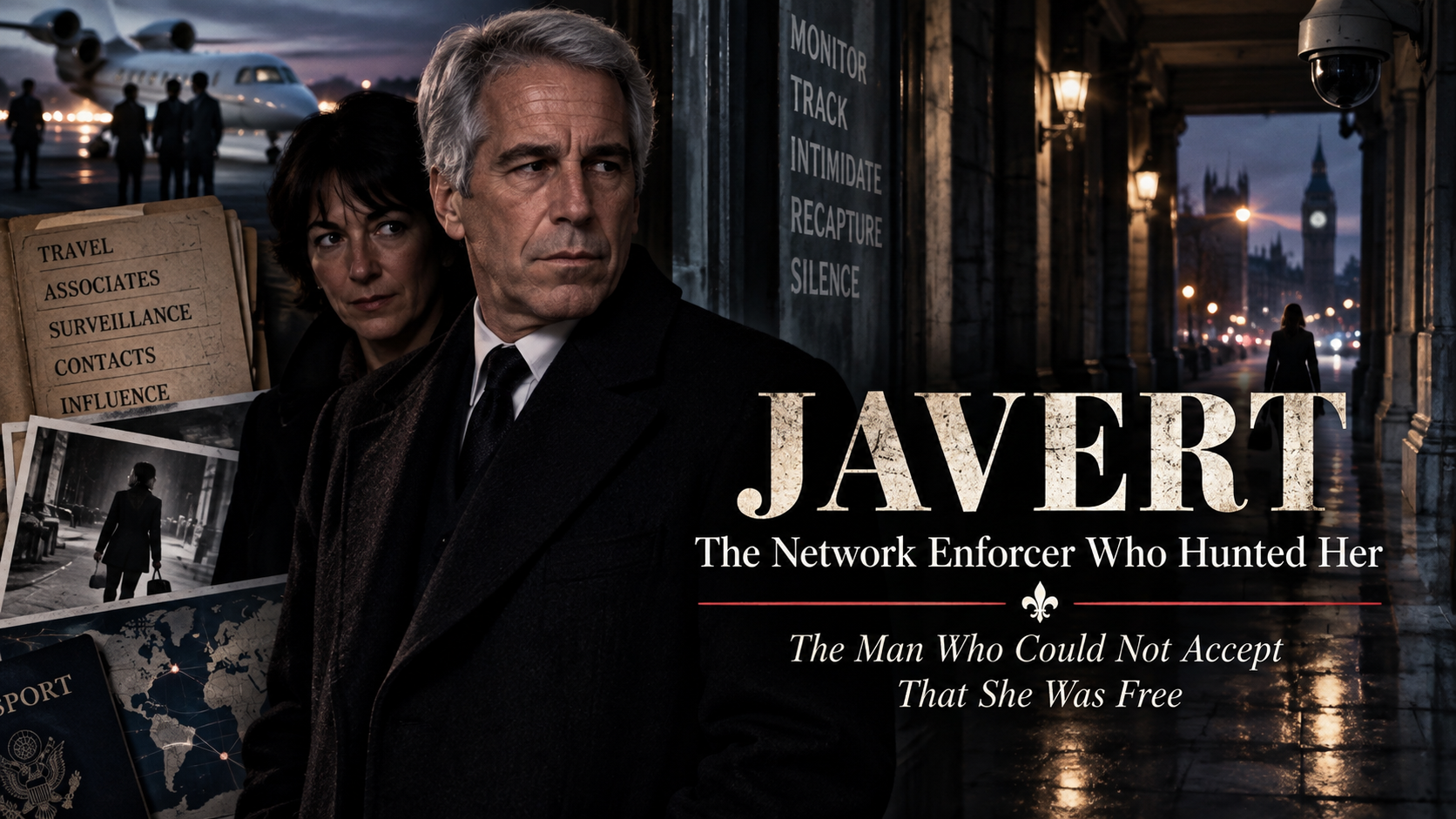
The Man Who Could Not Accept that She was Free and Hunted Her Like An Animal Across Decades.
In Scotland’s Les Miserables, Javert is a man inside the trafficking organization who pursued Victoria obsessively across decades, enforcing the will of the system with relentless determination. To her, his singular mission appeared to be to track, intimidate, recapture, and silence her whenever she attempted to live freely outside the control of the network.
His pursuit of Victoria embodied the cold, merciless obsession found in Victor Hugo’s Javert, but within the landscape of modern trafficking — as he hunted her like an animal across decades —through surveillance, intimidation, retrafficking attempts, and proxy enforcement carried out both directly and through others working under him.
Like Javert in Les Misérables, his conduct appeared to Victoria to reflect an inability to tolerate escape, deviation, or the idea that someone he believed belonged to the system had become free. What began as trafficking evolved into a long-term pattern of surveillance, intimidation, stalking, sabotage, retrafficking attempts, and proxy enforcement carried out both directly and through others working under him.
At times, he appeared personally during trafficking incidents and confrontations. At other times, individuals connected to the organization acted on his behalf — carrying out calculated abductions, intimidation, monitoring, and coercion while he operated from the background. To Victoria, the pursuit often felt larger than one individual man, as though an entire system had been activated to prevent her from escaping the life they intended for her.
Even after Victoria was rescued and reunited with her family, the pursuit did not fully end. Attempts to destabilize her life continued through interference with relationships, career paths, housing, ministry environments, travel, and personal safety. Periods of freedom were repeatedly interrupted by new attempts to force her back under the influence or control of the trafficking network.
During later encounters, he reportedly made clear to Victoria that he viewed her as one of the people most dangerous to him because of the possibility that she might publicly speak about what had happened.
the pursuit was also about silence —She Was Dangerous Because She Could Tell the Story.
To Victoria, the pursuit did not appear to be motivated only by a desire to force her back under the control of the trafficking network. As she grew older, another danger became increasingly important: she could talk.
She had memories of the people, places, methods, relationships, and systems surrounding the trafficking environment, and those involved had expressed to her that they feared what could happen if she ever spoke publicly or brought those memories to journalists, investigators, or the wider public.
In that sense, the pursuit was not only an attempt to recapture someone who had escaped.
It was also an attempt to prevent the witness from becoming a voice.
During later encounters, Victoria says Javert made it clear that he regarded her as particularly dangerous because she had survived, remembered, and might eventually tell the story. He was especially concerned about the possibility of another girl coming forward, as Virginia Giuffre had done. He referred to his efforts to recapture Victoria as “preventative measures.”