The Inherited Machinery of Power: When Power Becomes Permanent.
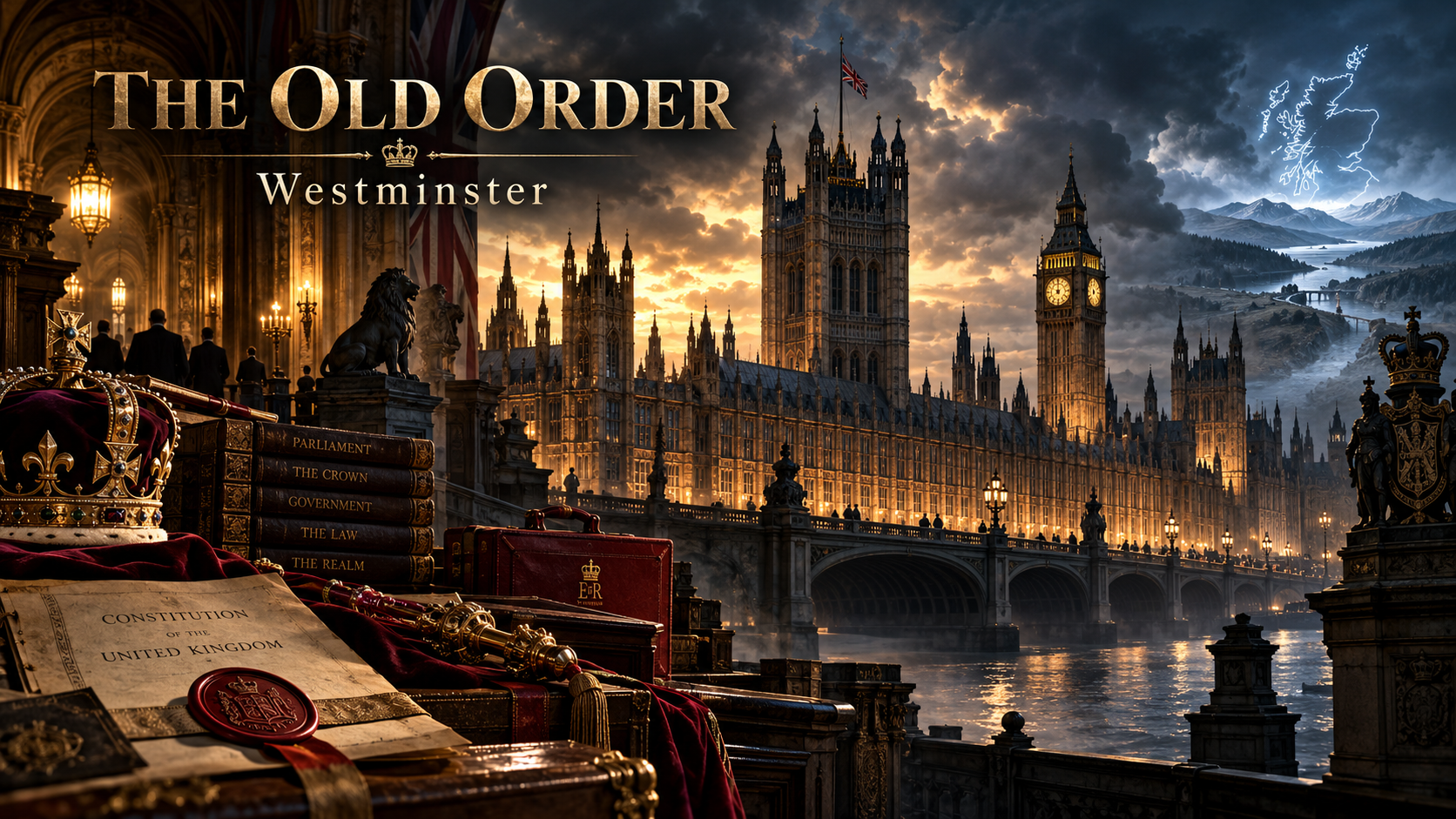
In Scotland’s Les Misérables, “The Old Order” represents the entrenched structures of monarchy, government, aristocracy, and institutional authority that protected powerful insiders while leaving ordinary people vulnerable.
It is the world of inherited influence, elite continuity, political deference, and centralized power — systems so deeply rooted that challenging them often felt impossible from within.
The Old Order represents more than individual people. It is the inherited system itself — centralized, entrenched, institutionally protected, and difficult to confront or escape. The closer institutions became to inherited power, elite continuity, and centralized authority, the harder it became to challenge individuals protected by those same structures.
This environment created conditions where reputation, influence, institutional loyalty, and political relationships could at times override transparency and accountability.
Powerful Individuals Were Often Shielded Not Merely By Money Or Status Alone, But By Longstanding Institutional Systems Designed To Preserve Themselves.
But systems of power do not operate by themselves.
Behind the prestige, titles, institutions, and public image were people whose positions allowed the machinery to keep moving — facilitators, intermediaries, officials, protection personnel, legal figures, and others who could use institutional access, government authority, paperwork, legal arrangements, introductions, diplomatic protections, and bureaucratic mechanisms to make questionable situations appear legitimate or pass without challenge.
Victoria remembers encountering this hidden machinery repeatedly within the trafficking world.
She identifies one man she encountered — known among colleagues as “The Prince of Darkness,” which she points out is “one of the names of Satan” — as someone she understood to handle legal matters connected to Epstein and her child trafficking situation.
She explains that he was Epstein’s go-to person for an assortment of legal matters surrounding her child trafficking arrangements.
Victoria also remembers trafficked children being moved through customs in New York City without the kinds of questions she would have expected authorities to ask.
She recalls another incident in which members of law enforcement declined to arrest Andrew Mountbatten-Windsor and others traveling with him after she reported herself as the victim of trafficking activity.
She remembers being told that they could not arrest them because they were traveling under the protection of “diplomatic immunity.”
She also remembers protection officers of Andrew Mountbatten-Windsor and other government-connected officials standing by with silent obedience during trafficking incidents rather than intervening.
Victoria describes them as standing “like silent statues.”
She remembers running to them for help as a nine-year-old girl because she understood them to be like police. She cried for them to take her home — back to her family and her father.
According to Victoria, they refused to help her “with faces like steel.”
Instead of helping her leave, she remembers them preventing her from leaving Epstein’s house and continuing to obey the powerful adults around them.
To Victoria, these moments came to symbolize one of the darkest dimensions of The Old Order: powerful systems did not survive simply because of the people at the top.
They survived because other people kept obeying.
They survived through paperwork, protected passage, legal authority, institutional loyalty, prestige, silence, and the willingness of people inside established systems to defer to power rather than challenge it.
The Machinery Survived Because Power, Paperwork, Protection, And Silence Kept It Moving.
For Victoria’s father and others who supported Scottish independence, this became deeply connected to the constitutional relationship between Scotland and Westminster itself.
To many Scottish independence supporters, the fact that Scotland could not simply authorize its own permanent referendum for independence without Westminster’s approval symbolized a deeper constitutional imbalance at the center of the union — a nation seeking sovereignty while ultimate authority remained elsewhere.
This contradiction was symbolic of The Old Order itself: systems of inherited authority so deeply established that even attempts to peacefully separate from them still required their permission.
Within Scotland’s Les Misérables, Westminster therefore becomes more than a location or political institution. It becomes a symbol of centralized power, institutional permanence, elite protection networks, and the difficulty of confronting systems that have existed for generations.
The Old Order is the world that allowed powerful individuals to operate behind prestige, status, institutional loyalty, diplomatic protection, and public image while ordinary people — especially vulnerable children — struggled to be heard, protected, or believed.
In Les Misérables, the revolution does not rise against a distant medieval world, but against a society in which old hierarchies, poverty, political exclusion, and inherited structures of authority still shape everyday life long after the French Revolution itself.
Victor Hugo’s young revolutionaries confront a system they believe has failed to deliver the freedom, dignity, and justice promised by earlier upheaval.
In Scotland’s Les Misérables, The Old Order serves a similar purpose: it represents inherited structures of power that remain standing even after generations of reform, and the question of whether systems built around centralized authority can ever truly be transformed from within.
Just as Victor Hugo’s young revolutionaries challenged an entrenched political order, Scotland’s constitutional struggle becomes a modern confrontation with the permanence of inherited power.
The Old Question Remains: How Long Should Inherited Power Endure Simply Because It Has Endured Before?
In modern times, Scotland’s struggle is not merely a political disagreement, but a struggle against inherited systems of power viewed as too entrenched, too protected, and too intertwined with themselves to willingly expose their own corruption.