
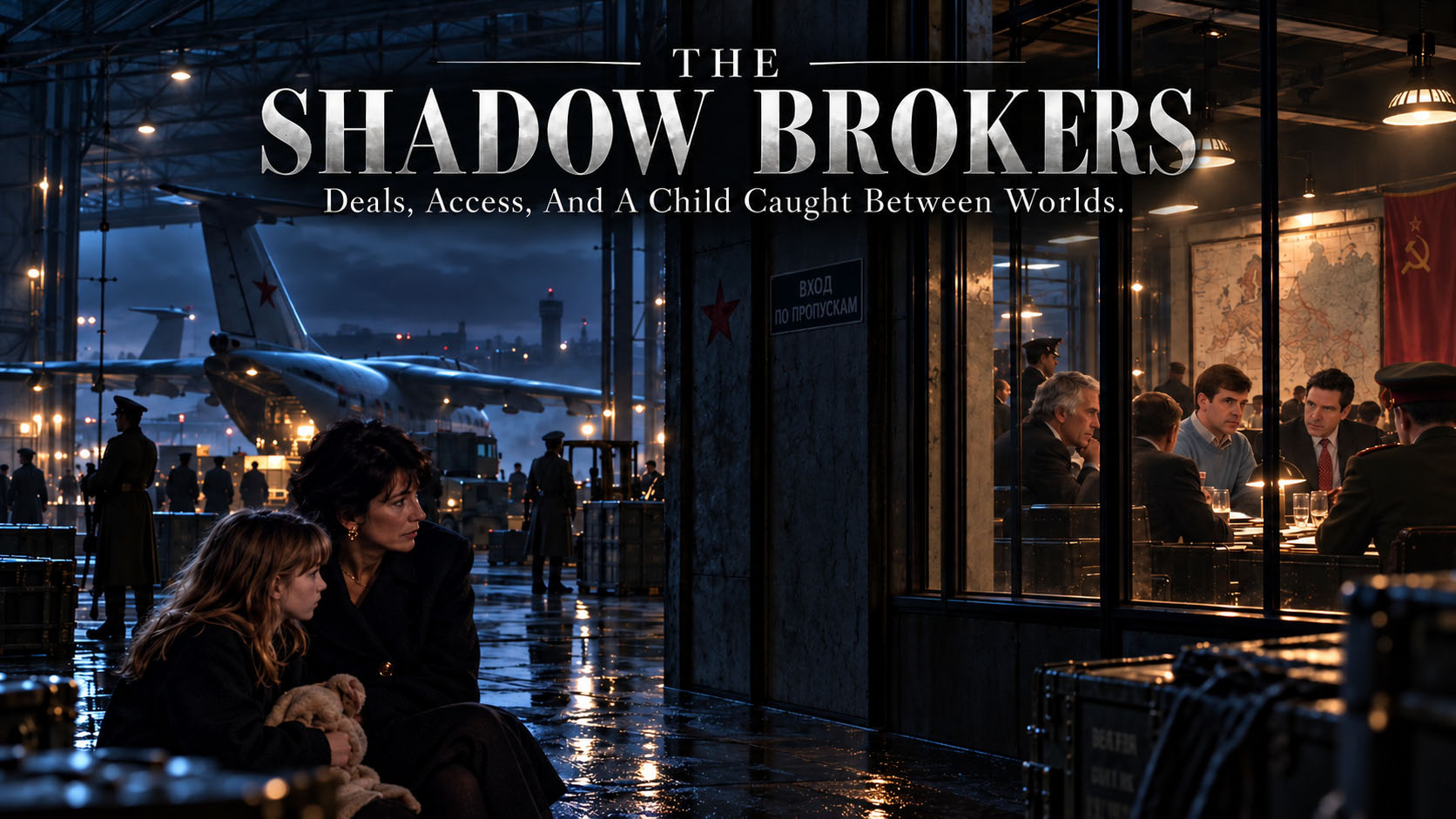
The Hidden Hands Behind Kyiv: Deals, Access, And A Child Caught Between Worlds.
Kyiv, autumn 1989.
The Soviet Union was still standing, but the world around it was changing with extraordinary speed.
Across Eastern Europe, political structures that had appeared immovable were beginning to fracture. Poland had already installed a non-Communist-led government. Hungary had opened its border with Austria. East Germany was facing escalating demonstrations and departures.
Eight days after the date Victoria remembers being in Kyiv, the Berlin Wall would fall.
Ukraine itself was in political upheaval.
Only weeks earlier, on September 28, Mikhail Gorbachev had made a surprise trip to Kyiv during a dramatic change in the leadership of Soviet Ukraine. Longtime Ukrainian Communist Party leader Vladimir Shcherbitsky was removed, and Vladimir Ivashko succeeded him after a secret ballot in which Stanislav Gurenko was also a candidate.
At the same time, Soviet economic weakness was becoming increasingly visible.
On October 25, only days before Victoria’s arrival, Soviet authorities announced a tenfold reduction in the ruble’s value for certain foreign-currency transactions. The ruble could not be freely converted into dollars and other Western currencies and had virtually no value outside the Soviet Union.
Contemporary reporting described the decision as an acknowledgment of the enormous difference between the ruble’s official value and its actual purchasing power, while Soviet authorities struggled to capture badly needed hard currency.
And on October 31, President George H.W. Bush publicly announced that he and Gorbachev would hold an unexpected “interim informal” meeting in December aboard American and Soviet naval vessels in the Mediterranean. Bush said there would be no fixed agenda and linked the meeting to the extraordinary speed of events transforming Eastern Europe.
It was into this unstable, rapidly changing world that Victoria was brought after being abducted from Britain.
She was eight years old.
She remembers arriving in Kyiv in darkness.
She remembers being a passenger on an aircraft entering an enclosed military aviation hangar connected closely with offices and meeting rooms. She did not pass through anything resembling an ordinary civilian airport terminal.
Instead, she remembers entering a world of military personnel, unfamiliar officials, introductions, closed doors, telephone calls, and meetings she was far too young to understand.
Names circulated around her that she struggled to pronounce — particularly Russian surnames beginning with “G.”
They were discussed by her travel companions as important people, including individuals they apparently expected to encounter in Kyiv.
Gorbachev was discussed.
Gromov was discussed.
Other names were discussed.
General Boris Gromov had become commander of the Kyiv Military District in 1989 after commanding Soviet forces in Afghanistan.
Victoria remembers Gromov’s name being discussed as one of the important Soviet figures the travelers expected to encounter in Kyiv. While there, she believes she encountered him and may have shaken his hand.
Some conversations were associated generally with “Gorbachev,” while others may have concerned Gromov or other Soviet officials whose unfamiliar names beginning with “G” were difficult for an eight-year-old English-speaking child to distinguish.
What Victoria Could See — And What Remained In The Shadows
Victoria remembers the visible participants.
She remembers Ghislaine Maxwell.
She remembers Jeffrey Epstein.
And she remembers two additional men traveling with the group, each connected to extremely powerful families and institutions and each representing the interests of a parent.
But the people Victoria could see were only one layer.
Behind them were people she could not identify.
The person who arranged access for the travelers.
The person expecting the delegation.
The people on the other ends of telephone calls.
The person who had negotiated what was supposed to happen to Victoria before the aircraft arrived.
The people determining terms Victoria could hear being argued about but could not understand.
And whoever was ultimately supposed to receive her.
These are The Shadow Brokers.
The Shadow Brokers are not simply a list of secretive people. They are the unseen machinery behind the international child trafficking transaction of which Victoria was a victim — people she could only partially witness.
She knew people were operating behind the scenes, coordinating circumstances she could see unfolding around her, but she did not know who all of them were.
They are the people, agreements, introductions, permissions, telephone calls, negotiations, and arrangements operating in the shadows behind what an eight-year-old child could actually see.
A New Participant Who Was “On A Roll”
Victoria’s memory places Ghislaine Maxwell and Jeffrey Epstein together in this environment in 1989.
That is significant because Maxwell has publicly maintained that she first met Epstein in 1991.
But independent investigative work has challenged that timeline.
In 2021, researchers behind the documentary Ghislaine Maxwell: Epstein’s Shadow told The Guardian’s Observer that, after interviewing more than 200 sources and extensively cross-referencing testimony and court records, they concluded that Maxwell knew Epstein in the late 1980s — although they were unable to determine exactly when the relationship began.
That independent reporting is consistent with Victoria’s firsthand recollection of Maxwell and Epstein already knowing one another in 1989.
But Victoria’s connection to that question is more consequential than simply having witnessed the two of them together.
According to Victoria’s account, she was the eight-year-old child being trafficked through arrangements in which Maxwell and Epstein were participating.
Victoria remembers their relationship in 1989 as appearing relatively new in one sense, although she cannot determine exactly how recently it had begun.
Epstein was being described as something of a “new guy.”
Victoria remembers hearing that he had already been taken to a series of other meetings, where the people traveling with him had been watching what he could accomplish.
Adults discussed his “track record.”
At eight years old, Victoria interpreted the expression literally.
She thought they were saying Epstein had a record involving a running track.
She even asked whether they were discussing him competing as a runner in the Olympics.
The adults found the misunderstanding amusing.
What Victoria understood only much later was that they appeared to be discussing Epstein’s recent transactional business performance — what he had accomplished in earlier meetings and why the people traveling with him believed he was worth bringing into another one.
She remembers him being described as “on a roll.”
Yet there was another side to Maxwell’s behavior that complicates the picture.
Victoria remembers Maxwell already displaying considerable confidence in Epstein.
When problems developed, she remembers Maxwell saying things such as:
“Jeffrey will know what to do. He always knows what to do.”
Victoria remembers Maxwell appearing intensely invested in the negotiations. She describes her sitting on the edge of her seat, almost holding her breath, as though she were waiting to see whether the “new guy” could deliver again.
To Victoria, those memories suggest an existing degree of familiarity and trust between Maxwell and Epstein even while Epstein was apparently being introduced as new to something occurring around the group.
What exactly he was “new” to, Victoria does not know.
It simply records the contradiction Victoria remembers: a man being presented as a relatively new participant, while Maxwell already spoke about him with striking confidence.
Victoria has wondered whether her own trafficking experience in Kyiv may help explain why the publicly stated timeline of their relationship began later than the period described in her account.
That remains a question for investigative journalists.
Fragments From Behind Closed Doors
According to Victoria’s testimony, she was in Kyiv, Ukraine, during the early morning hours of November 1, 1989, before sunrise, with Epstein and Maxwell.
Adults moved between offices.
Doors opened and closed.
Fragments of conversations reached Victoria before participants disappeared into larger meetings.
She remembers discussions involving money.
She remembers “arms” being discussed — weapons, missiles, bombs, explosives, guns, and an arsenal.
But when she first heard adults talking about “arms,” Victoria misunderstood the word completely. She thought they were talking about human arms.
It became another childhood misunderstanding that amused the adults traveling with her.
She remembers Epstein being presented as someone who could solve problems and make things happen.
And she remembers one sentence particularly clearly.
She recalls Epstein telling Soviet participants words to the effect of:
“What I’m offering you is hard U.S. dollars. Your currency is worthless.”
At eight years old, Victoria knew nothing about Soviet exchange policy.
She did not know that only days earlier Soviet authorities had dramatically altered the ruble’s exchange value for certain transactions.
She did not understand why Western currency mattered.
She simply remembered what she heard.
Two Things Appeared To Be Happening At Once
One of the most difficult parts of Victoria’s memory is that the events surrounding her did not appear to consist of one simple negotiation.
While several of the men entered a conference room for formal discussions, Victoria and Maxwell remained outside, where they could sometimes see into the room through glass.
Victoria remembers watching the meeting while Maxwell reacted closely to what was happening inside.
To Victoria, Maxwell behaved as though the success or failure of the discussion inside that conference room mattered to whatever was supposed to happen next.
But at the same time, another process was occurring.
Victoria remembers Maxwell moving into another office to make telephone calls concerning arrangements for someone to come and receive Victoria.
Those calls appeared to involve people who were not inside the conference room.
The arrangements sounded as though they had already been established before the travelers arrived in Kyiv.
That creates a question Victoria still cannot answer.
Was any of the business being negotiated inside the conference room directly connected to the transaction involving her?
Was it separate business occurring alongside their child trafficking arrangements regarding her?
Did one negotiation provide access or conditions necessary for another?
Were several transactions occurring simultaneously?
Victoria does not know.
What she remembers suggests multiple layers of arrangements operating around her at the same time — some visible through the conference-room glass, others occurring through telephone calls and contacts she could not see.
That uncertainty is itself part of the backdrop of mystery surrounding The Shadow Brokers.
Glasnost — And A “Humanitarian Mission”
Victoria also remembers Ghislaine Maxwell invoking glasnost as part of the explanation for why she was traveling in the Soviet Union.
Maxwell presented herself and Victoria as being there separately from some of the men in the party — supposedly as part of a humanitarian mission.
In Victoria’s account, that meant something far darker than the phrase suggested.
Maxwell was describing the very journey in which Victoria was being trafficked as a “humanitarian mission.”
The language supplied an acceptable explanation for the presence and movement of a child at that location during that extraordinary moment in Soviet history.
What appeared outwardly to be discussed as humanitarian travel was concealing something entirely different.
A Transaction That Already Existed
Victoria’s account of Kyiv does not begin with someone meeting her there and then deciding what to do with her.
The arrangement appeared to have existed before she arrived.
She remembers being taken to a medical examination room at the military facility where measurements, physical identifying information, biometric data and other identifying information were collected.
She remembers being photographed naked from different viewpoints and angles.
She remembers the photographs being discussed in front of her as images intended to be shown to the person who was supposed to receive her before the sale was completed.
She remembers adults discussing what was supposed to happen to her.
She remembers waiting outside with Maxwell while the men were inside the conference room.
While outside, she remembers Maxwell repeatedly attempting to obtain telephone access.
To people passing nearby, Victoria and Maxwell could appear simply to be a mother and daughter waiting outside a business meeting. Victoria remembers that some people consequently assumed Maxwell was her mother.
She remembers Maxwell arguing over the telephone with someone concerning timing, terms, price, or some combination of those matters.
At one point soldiers assembled inside the hangar in a way that frightened Victoria.
Unable to understand what was happening politically or militarily around her, she wondered whether a war was beginning.
Then the atmosphere changed.
The soldiers began behaving more like workers handling the ordinary movement of a large transport facility, taking boxes, crates, and other cargo on and off aircraft.
Meanwhile, Maxwell was furious with someone on the other end of the telephone.
Something was going wrong.
Victoria then remembers watching Epstein run out of the conference room, loudly announcing that the “deal” was off.
But what deal?
Was he talking about Victoria?
The weapons discussions?
Another matter entirely?
Several negotiations tied together?
All of the above?
Victoria has no idea.
She remembers some of the adults nevertheless sounding confident that the other side might eventually change its position.
Whatever had been planned for Victoria in Kyiv did not happen as intended.
She still does not know who was ultimately supposed to receive her.
She does not know whether the intended recipient was connected to the military, the Soviet government, another organization, a private individual, or some combination of people operating behind the scenes across those worlds.
She does not know how the people Maxwell was telephoning related to the people negotiating inside the conference room.
Those are precisely the parts of the transaction that remained beyond the child’s view.
But something had been arranged before Victoria arrived.
There had been contacts.
There had been access.
There had been meetings.
There had been telephone calls.
There had been negotiations.
There had been people expecting something to happen after she arrived.
Victoria could see the people immediately around her.
Beyond them were the people she could not see, the agreements she did not hear in full, the introductions that had already been made, the permissions that had already been obtained, the terms she could not understand, and the people waiting on the other side of arrangements that existed before the aircraft ever reached Kyiv.
The Shadow Brokers were the people, agreements, and arrangements operating behind the visible participants — the unseen trafficking machinery coordinating circumstances Victoria could perceive only in fragments.
Victoria may never know all of their identities.
But she knows their arrangements existed because she was the child caught inside them.
For an abducted eight-year-old child to arrive inside that world with a transaction already waiting, someone had arranged what would happen before the aircraft ever left the ground.